


Good morning leaders! Happy Friday.
Did you land in a good place with brand investment activity from last week?
🗣️ We have been asked a few times recently if you can write for Marketing Unfiltered, of course if you have something unfiltered or helpful for marketing leaders please submit your idea here.
Update: There has been a new set of job scams targeting senior and marketing execs, I have updated our job scams post to ensure you are kept across them, one includes answering questions as part of an “interview” to train and personalise AI tools. Be aware!
Onto this week, I am diving into the world of Substack and how brands can build a richer hub. I break down the features you can explore and why some brands have found their new canonical home, whereas others have been DOA by just replicating their boring SEO and AEO blogs on a platform that rewards being way more.
By Danny Denhard - Coaching marketing leaders, consulting with marketplaces and challenger brands and advising business & marketing leaders.
Is The Substack The Next Home For Your Brand?
Should we put our brand on Substack? Is a question I’m asked regularly.
When I ask why and what the benefit is, I am pushed to the social media manager or the content lead, who’s struggling to gain influence with those around them.
In a few more recent conversations, Substack has been brought up; here are some of the questions:
Should we replace some of our social channels with Substack?
What would I do in a CMO seat with Substack?
Shall we remove our CRM and move to Substack?
Would I let Substack become a home and hub for many brands who want to leverage the platform?
So, Why Substack?
Substack has arguably become a verb; it’s what people write on, it’s more than just an email and perceived more than a blog. It reminds me of the traction Blogger (remember it before Google left it die) got in the early days.
It’s a platform that wanted to be a simple and free-to-low-cost ESP for writers, journalists and podcasters; it evolved to become a platform with different mechanisms, from first-party ownership concerns with subscriptions to a follow graph which you do not own.
Substack is trying to become a social platform, and it’s arguably done that for a small subsection of app users.
Just A Blog? No!
For most, Substack is just a blog that sends out their email for others who’ve understood the sub-culture of the platform, especially inside of the app.
Substack became a place for “authentic voices”, a place to send emails, become creative and feel like a space where brands could engage, be safer to experiment and allow customers to hit reply.
Although this isn’t a new feature it has built out a new wave of companies wanting to engage and build relationships.
Substack does hold a small grasp on culture in the US and in very specific niches so it’s worth researching this a little further.
Substack More Than Email, But Is It Guiding Behaviour Change?
Substack wants to influence and shape culture by what its users say and do and it might have just done that but it’s taken brave and bold writers, podcasters and specific maverick brands who want to challenge culture, write in safer spaces and say what they mean without the fear of being filtered by Gmail and Outlook or by broader algorithmic updates.
It’s become more than email for many as it enabled people to connect more thoughtfully to writers, to consultants and to brands who wanted to act more editorially and write more authentically.
One important factor, Substack is now more similar to Patreon they have their own follow (their social graph) graph, if someone chooses to follow you but not to subscribe, you will not own that relationship and cannot contact them directly (or export if you decide to leave Substack).
I had one of many fascinating conversations with friend of MU Chris (Hutchings) and one conversation has stuck in my mind and I constantly ask, as brands should we build an audience to convert into customers?
Is this a different way to think as we all operate as media brands? And is Substack a channel for that?
What Smart Brands Are Doing
Within the brand editorial landscape on Substack, several companies look to stand out by moving completely away from blogs, newsletters and more traditional product promotions emails they send. This approach falls flat on its face!
Many fell into the SEO trap of writing blogs to rank for keywords, not to add value to readers or your customers. Although this approach still happens on Substack it’s not tolerated and in some cases it’s rejected loudly.
Instead, they are treating the platform as a genuine publishing house, using proprietary data, literary commissions, unapologetic cultural commentary, and radical operational transparency to build real audience affinity.
I always remember being told never to go near the 3P’s (never be seen near poker (gambling), pills (pharma or non-vitamins), p— (anything related to sex would cause problems) in any marketing, however, many of these categories are thriving on Substack and that reflects recent cultural changes and societies openness to discuss these topics.
I created a list of great examples, and here are the brands doing the most unique and interesting things, grouped by their editorial strategy:
The Standout Substack Brands
The Proprietary Data Playbook: Ramp
The Publication: Ramp Economics Lab
Why it’s unique: Rather than offering generic financial advice, the corporate card and spend-management platform uses its vast, aggregate transactional data to deliver uniquely grounded economic dispatches. Led by their economist Ara Kharazian, the publication tracks real-time SaaS market vendor rankings, corporate AI adoption, and employment shifts.
Why it works: It balances high-integrity data with a witty, casual, internet-native voice. Memorable essays like “Claude didn’t kill design apps,” “We can finally say AI isn’t killing jobs,” and “My application to the infamous OpenAI Influencer Summer Camp” show that B2B writing doesn’t have to be boring.
The High-Concept Literary Project: Hinge
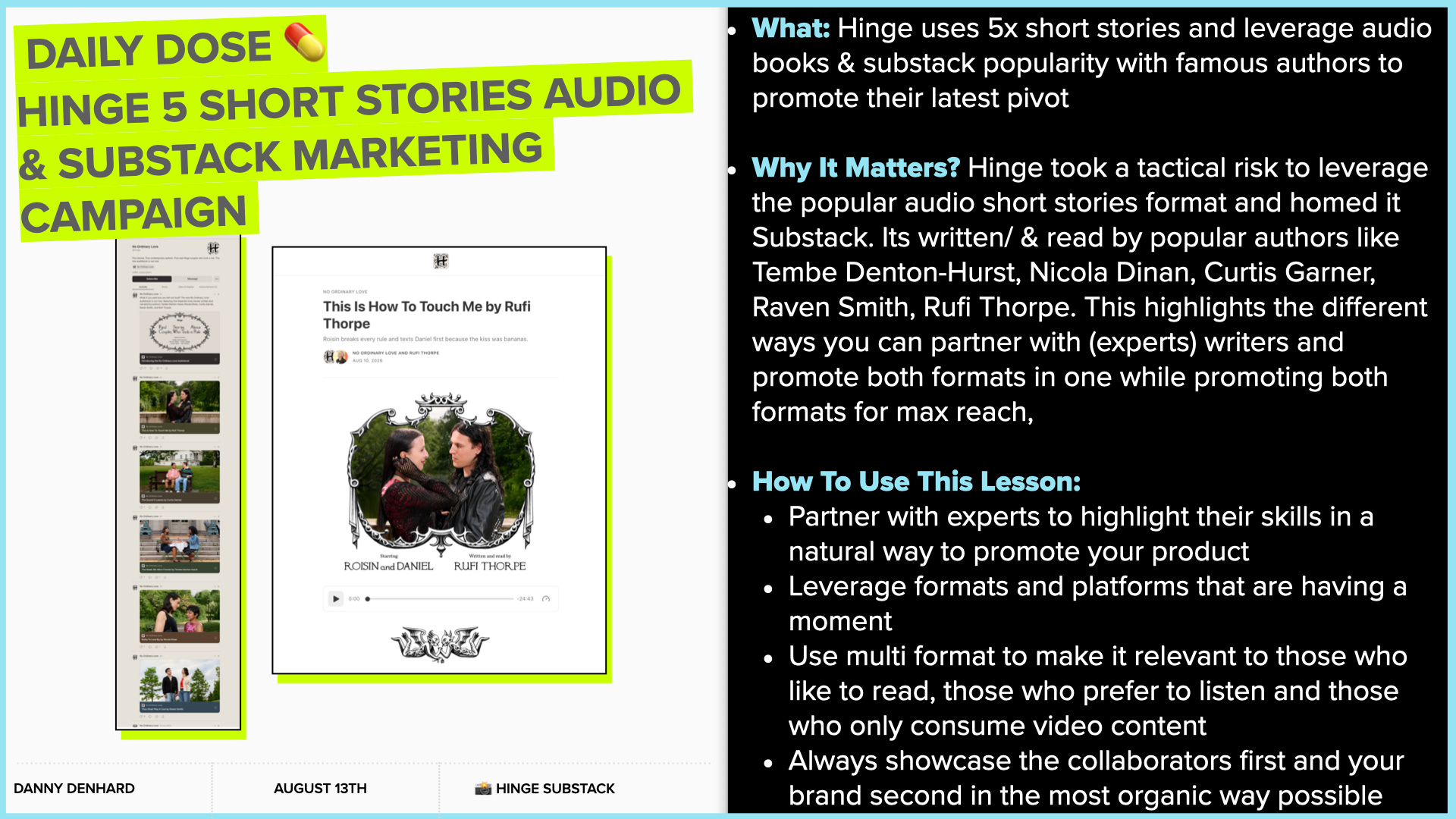
The Publication: No Ordinary Love
Why it’s unique: Hinge has elevated dating app success stories into a fully produced literary collection and audiobook. They commissioned prominent contemporary writers (including Rufi Thorpe, Nicola Dinan, Curtis Garner, and Raven Smith) to write and read deeply personal, real-life love stories of couples who met on the app.
Why it works: It shifts the conversation from app mechanics to the emotional reality of modern dating. Essays like Rufi Thorpe’s “This Is How To Touch Me” and Curtis Garner’s “The Sound It Leaves” explore the vulnerability, clumsy texts, and risks involved in building connection.
The Uncensored Youth Culture Dispatches: Julie & Dame
The Publications: Sex Happens (Brand: Julie) & No Bad Sex (Brand: Dame Products)
Why they are unique: In the sexual health space, these brands have built highly candid, unfiltered publications that read like indie zines rather than corporate blogs.
Why they work:
Emergency contraception brand Julie publishes Sex Happens, which leans into raw, unapologetic youth culture with titles like “She came, she saw, she pegged” and “Chucklefcker seeks reply-guy”*.
Sexual wellness brand Dame curates No Bad Sex, a highly thoughtful space featuring series like “Nightstand Sessions” (pleasure profiles of creatives), monthly astrologically-focused horoscopes (“Damescopes”), and “No Sex in the City” (an ongoing series examining celibacy and dating boundaries).
The Gritty Operations Diary: Island Creek Oysters
The Publication: Up the Creek
Why it’s unique: The Massachusetts-based oyster farm and cannery uses Substack to offer a deeply authentic, salt-of-the-earth look into the food supply chain.
Why it works: They brilliantly demystify food systems through deep dives like “Why We Made This: Tinned Razor Clams” and an on-the-ground report from North America’s largest lobster processing plant. They balance this heavy industry reporting with charming, human-centric team profiles under their “Odd Jobs” series—introducing readers to customer service reps (who double as World of Warcraft players) and property directors with excellent hair.
The Cultural Trend Forecasters: ShopMy
The Publication: Signals: A Publication by ShopMy
Why it’s unique: ShopMy (a creator commerce platform) bypasses product pitches in favour of deep, analytical cultural reporting on consumer behaviour and retail design.
Why it works: It acts as an industry-standard trend forecaster, analysing shifts in modern life. Standout essays investigate the broader sociological context behind shopping habits, such as “Why Does Every Brand Want a Book Club?”, “In the New Era of Body Care, the Shower Is a Stage”, and “Why Fashion Wants to Move In With You” (exploring why clothes shoppers now care about interior design and vacation destinations).
Other brands using Substack to be inspired by: Prof G Media (membership with exclusive content and livestreams), Concept Bureau, Ottolenghi (charging for premium subscription), and if you’d like to be founders led take inspiration from the likes of Bobbi Brown and Sophia Amoruso.
Education, Inspiration and Entertainment Works Again
As you have seen from these examples, there is a mix of value-add, showing off deep expertise (compelling niches are incredibly powerful in rich formats) and in some cases, blending both education and inspiration.
Many of the brands included are breaking the cultural norm and going that step further than blog posts. They offer richer media, often using images, short-form video and going deeper with the writing.
Beware Subscription Fatigue
What a lot of us have seen is subscription fatigue and what I call ask fatigue: we are subscribed to numerous emails, to numerous services and do we need more asks from brands? Even if they have repackaged and added huge amounts of value in a free email, and others have moved towards a premium newsletter model, charging a monthly subscription.
Be aware that it’s another channel, another ask and another subscription that many just don’t want.
How To Get The Most Out Of Substack
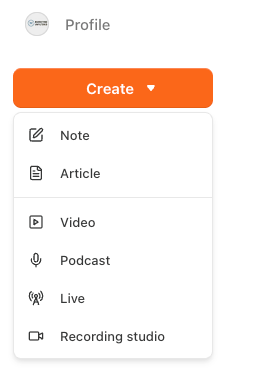
Audio
I recommended this in one of the original content ideas, many people are used to voice notes and dislike emails, one thing you can do is share audio, so a voice note to your audience, a song or something unique, something others won’t do. I love this approach and gives your audience something unique away from a forced branded WhatsApp community (I know some work, but 90% just don’t).
Video
Substack has evolved into a rich and multi media set up, adding native video that you have deliberately selected for Substack is a way to bring a different personality or style to your email. Jamie Oliver went deep into core subjects, something he wouldn’t have shared on his YouTube or TV channel but tested out concepts and went deep on unusual topics (like vinegar and spices), unfortunately Jamie stopped these but I encourage you to check these out.
You will notice I embed from other sources typically YouTube, many brands are using this methodology to hit their goals and KRs.
Chat
This is where the smart creators leverage chat, I know a few subscribers who subscribe to MKT1 (aka Emily Kramer) and Emily has used it really well.
Brands use it to have exclusive chats with subscribers, they leverage one-to-one and one-to-few conversations and can discuss elements of the newsletter, this is something they will happily pay for connection and pay for direct access. Many will run monthly office hours and equivalents and I suspect this might unlock some ideas for you and your brand.
Example: You can hit join chat to chat with us

Podcast
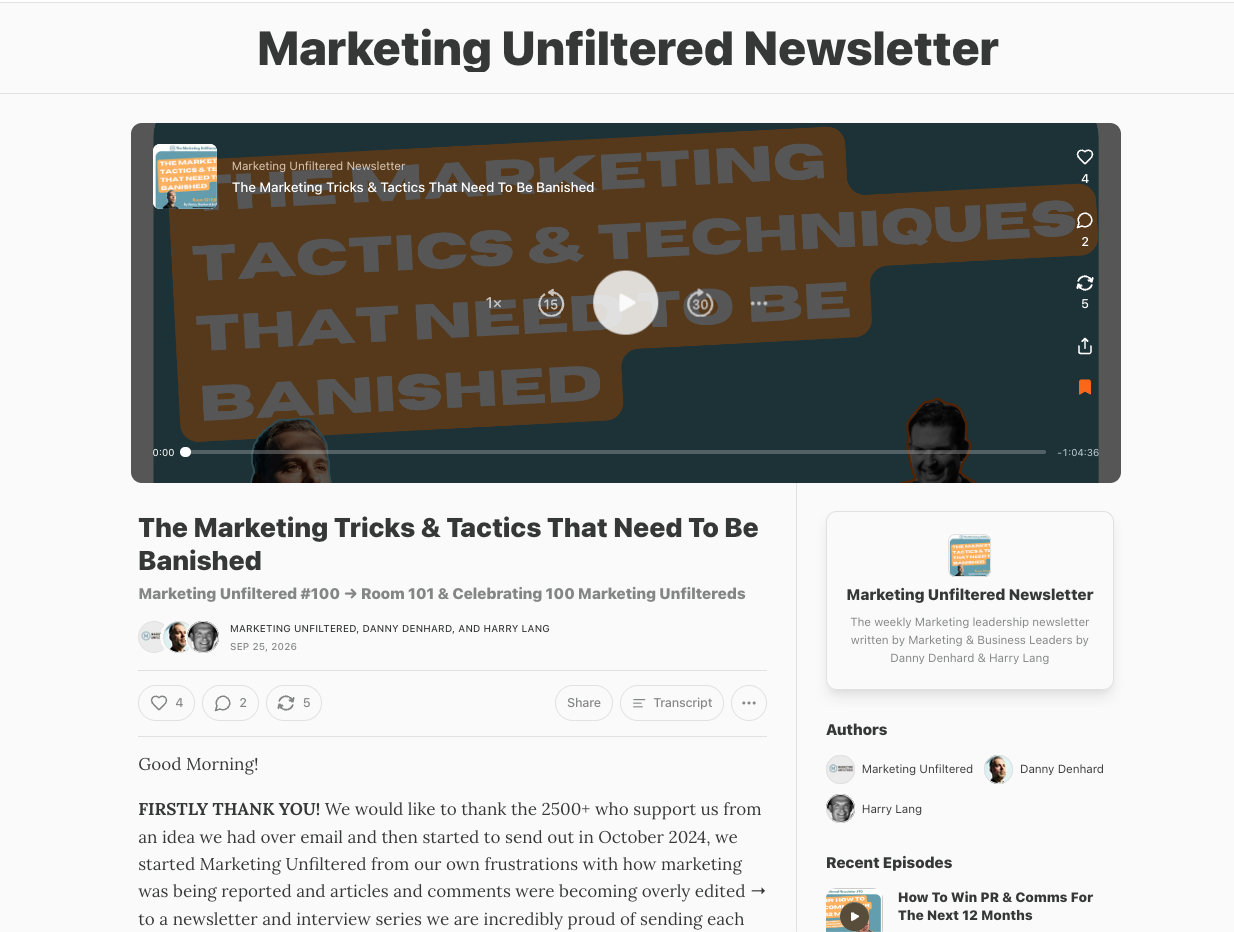
This is something I believe many brands can do better, leverage podcasts with direct email distribution. You can include podcasts in newsletters or send as a dedicated
You can also record podcasts within Substack admin area, just be mindful you will need to edit the audio for quality purposes, otherwise they often sound like a zoom call.
Livestream
Great for interviews and going live to discuss specific topics, products or releases. The interface is super simple and many previous contributors and many I have interviewed use the livestream feature.
Notes
This is their version of X or Threads, a way to send out teasers, updates and snippets of what’s coming up. I personally don’t see many traditional brands use notes other than copy paste of their other social media content but for the right brand notes could be a good corner of the internet for you.
Here is an example from Jamie Oliver
Importantly, you can self host on a domain (like we do on www.marketingunfiltered.co) or have a subdomain like many do (brandexample.substack.com)
If you want to be a media brand and offer a different and more modern experience, Substack can be for you, if you don’t get under the many layers of skin and the sub-cultures on Substack it might be a quiet place for you.
If you want to leverage a platform with a lot of community features and go beyond just emails and simple blogs then Substack could be the right platform for your brand or founder.
My Honest Verdict
Most brands won’t find their new or canonical home on Substack but many non mainstream brands could find a brilliant home and their community on Substack.
Thanks for reading and have a great week next week and we have an existing new contributor with their first MU take.
Danny Denhard
Here are 3 marketing examples to borrow from this week: