


Good morning and welcome back.
Thank you for the feedback on the Unfiltered Mark Ritson interview from last week, I’ve included some additional notes at the bottom of the newsletter to help you move forward into 2027.
» You can listen to the podcast on: Apple Podcasts, Spotify or watch us on YouTube
This week we have Naureen’s first MU, she goes deep on why household names are failing the AI shopping test & what 5k+ prompts across Claude, ChatGPT, & Gemini tell us about the new rules of consumer choice.
The Supermarket Trade Buyer Has a Rival, and It Doesn’t Care If You’re a Famous Brand
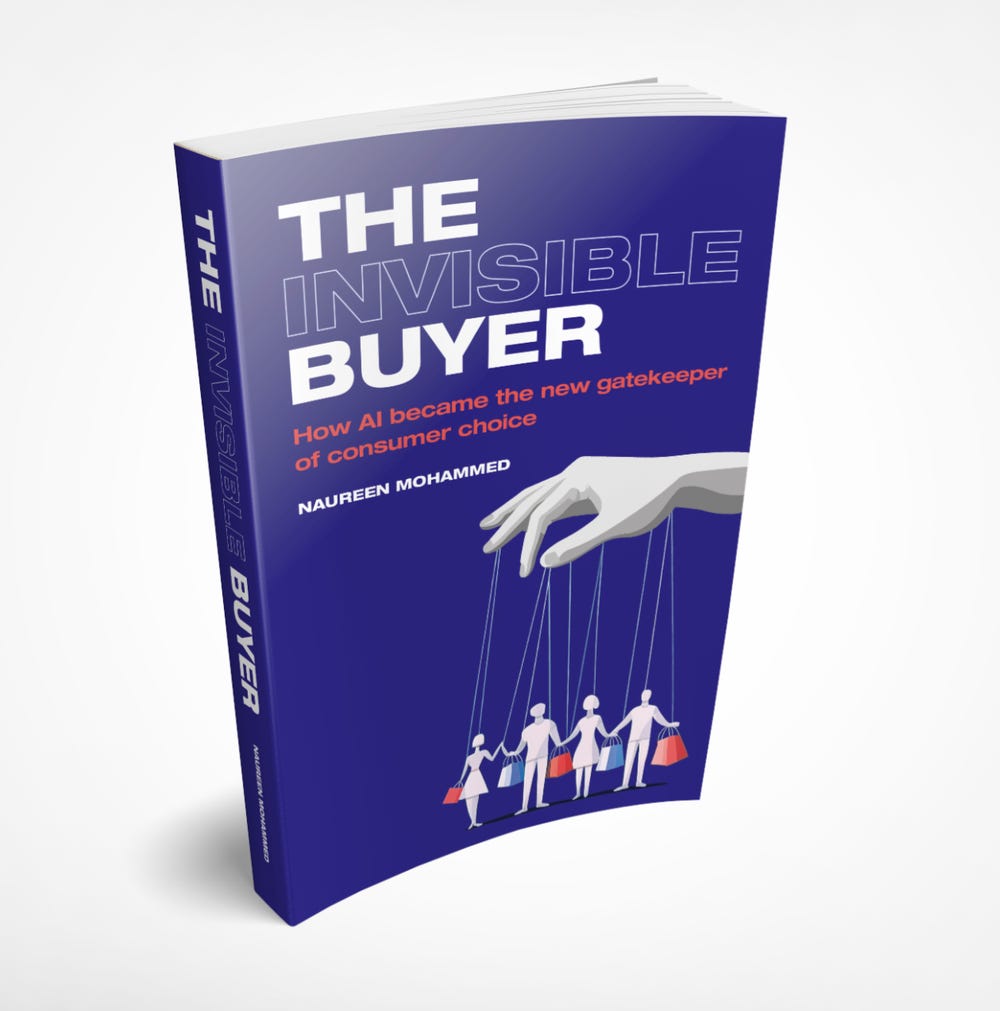
By Naureen Mohammed, author of the new book The Invisible Buyer.
Naureen Mohammed is the founder of CMO Growth Partners and the author of The Invisible Buyer: How AI Became the New Gatekeeper of Consumer Choice, out now. She spent twenty years building brands at Unilever, Beiersdorf and Johnson & Johnson, then ten years in tech at Meta and Pinterest, so she has seen how people choose from both sides: the shelf and the screen. Her AI Choice Audit tracks how AI assistants decide which brands to recommend. - Connect on LinkedIn
Download & Share as PDF With Your Team

Every consumer brand has always sold to two buyers: the supermarket and the shopper. Naureen Mohammed, author of The Invisible Buyer, introduces the new buyer in town. It runs a parallel path to the trade, straight to your customer, and she has found five traits in more than 5,000 AI answers.
This Black Friday, a lot of people started their shopping with a question to an AI assistant. About eight weeks before the sales, my team asked first.
We put 12 everyday Black Friday questions to Claude, ChatGPT (signed out), Gemini and Google’s AI Overview, five times each. Across those 240 answers, the average one named 7.8 brands, and only 10 settled on one. Sony appeared in all 20 headphone answers, and not one of them told the shopper which pair to buy.
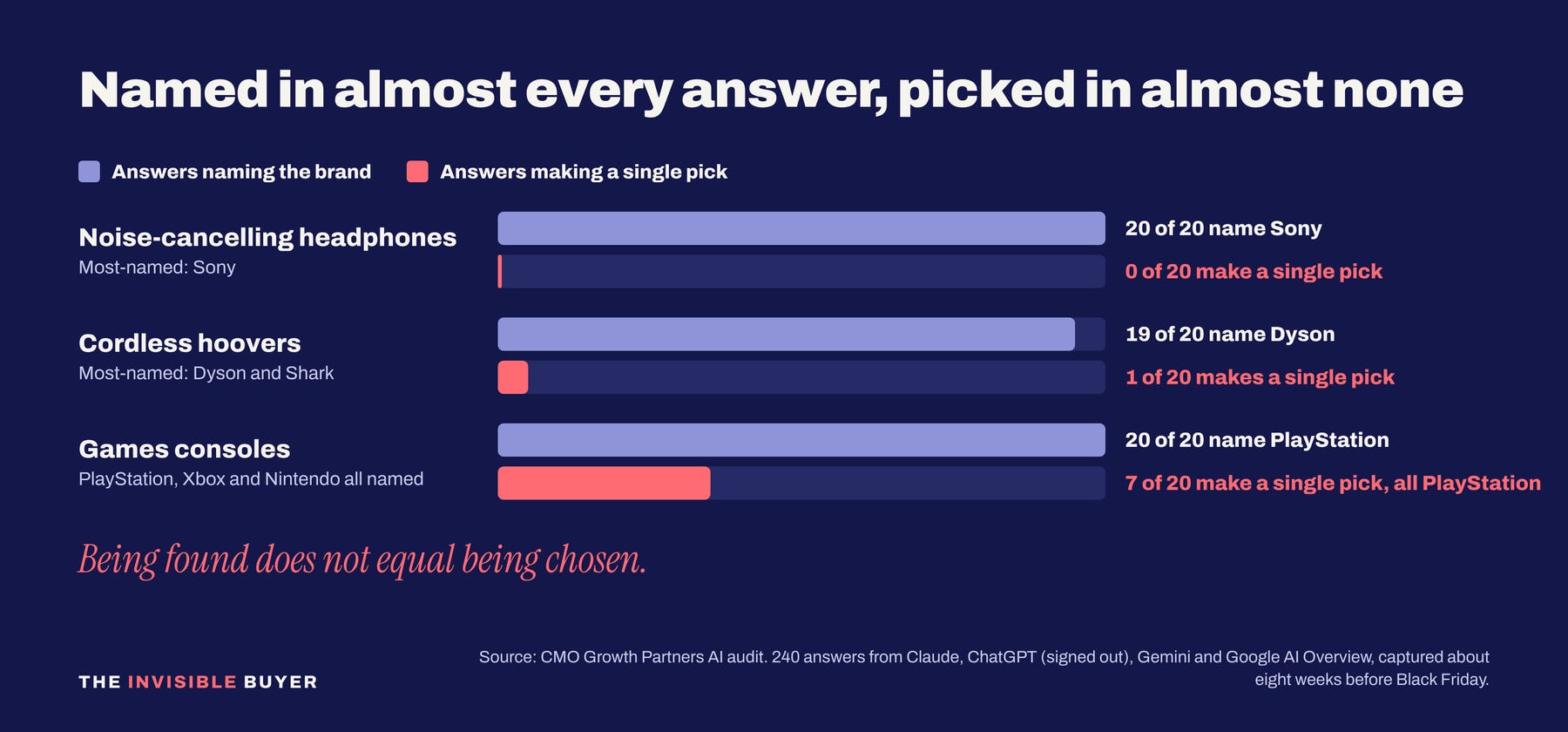
Named in almost every answer, picked in almost none. Source: CMO Growth Partners AI audit, 240 answers from Claude, ChatGPT (signed out), Gemini and Google AI Overview.
Before your customer has seen a single shelf, something has already decided which brands they hear about.
Every Brand Has Always Sold To Two Buyers
Anyone who has worked in consumer goods knows the first one: the trade buyer. The Tesco category manager may never use your product, but they decide whether it’s listed, how many facings it gets and where it sits on the planogram. You win them with a category growth story, trade investment and, more and more, retail media. You can phone them, present your deck and take them to lunch. The second buyer is the shopper, who decides what gets bought.
Now there’s a new buyer in town, and it runs a parallel path to the trade. When your customer asks an AI assistant what to buy, it shrinks a category of hundreds of brands down to three, and often recommends only one, straight to your customer. It does the supermarket buyer’s job, building the shelf before the shopper sees it, on a path the supermarket never touches. And you can’t take it to lunch. It forms its view from everything it has read about you, mostly written by other people, and it never tells you why you didn’t make the cut.
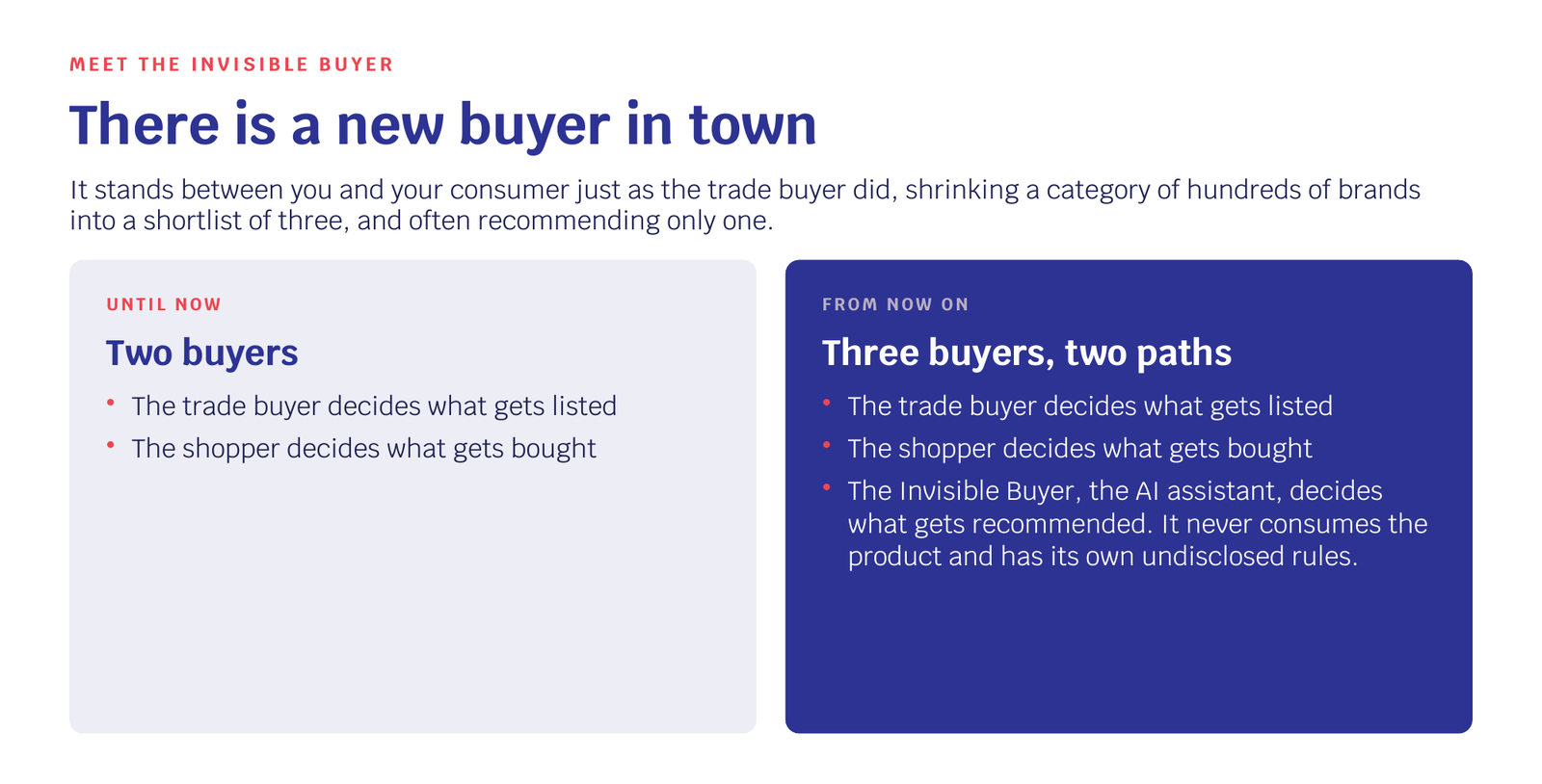
I call it The Invisible Buyer, and it’s the subject of my new book.
When I was at Meta, we’d have called this another surface, one more line on the media plan.
That would be a mistake. The Invisible Buyer behaves like a buyer, and every buyer has a personality.
Five Traits Of The Invisible Buyer
Before a range review, you knew which category manager wanted to talk about growth and which one wanted to talk about margin. Nobody knows The Invisible Buyer’s personality yet.
Across my AI Choice Audit, more than 5,000 AI answers across 13 UK consumer categories, five traits keep coming up.
1: It has made up its mind about some categories, but not all.
In pet food, Royal Canin and Hill’s take 42.2% of every top-three place across 600 answers.
In gin, the top two take 13.5% across 240. If you sell pet food, you’re trying to unseat an incumbent the AI assistant already trusts. If you sell gin, nobody has won yet. The open shelves are closing, though. In soft drinks, the leading brand’s share of top-three places went from 8.9% to 14.8% in a few months.
2: Change one word in the question, and it changes the planogram.
A supermarket planogram stays put until the next range review. The Invisible Buyer redraws its shelf every time someone asks. Ask for the best probiotic supplement and you get Culturelle, OptiBac, Bio-Kult and Alflorex: the vitamins aisle. Ask for the best probiotic drink and you get Biotiful, Yakult, Yeo Valley and Olipop: the dairy cabinet. One word moved the shopper to a different part of the store.
3: It doesn’t respect your category lines.
When I worked on the UK launch of Nivea for Men, we spent a long time negotiating with the Boots buyer over whether it belonged next to men’s shaving or women’s skincare. The AI assistant never has that conversation. Ask it for a face wash for oily skin or a dermatologist-recommended aftershave, and it recommends CeraVe and La Roche-Posay, which now sit in the top five of the whole male grooming category.
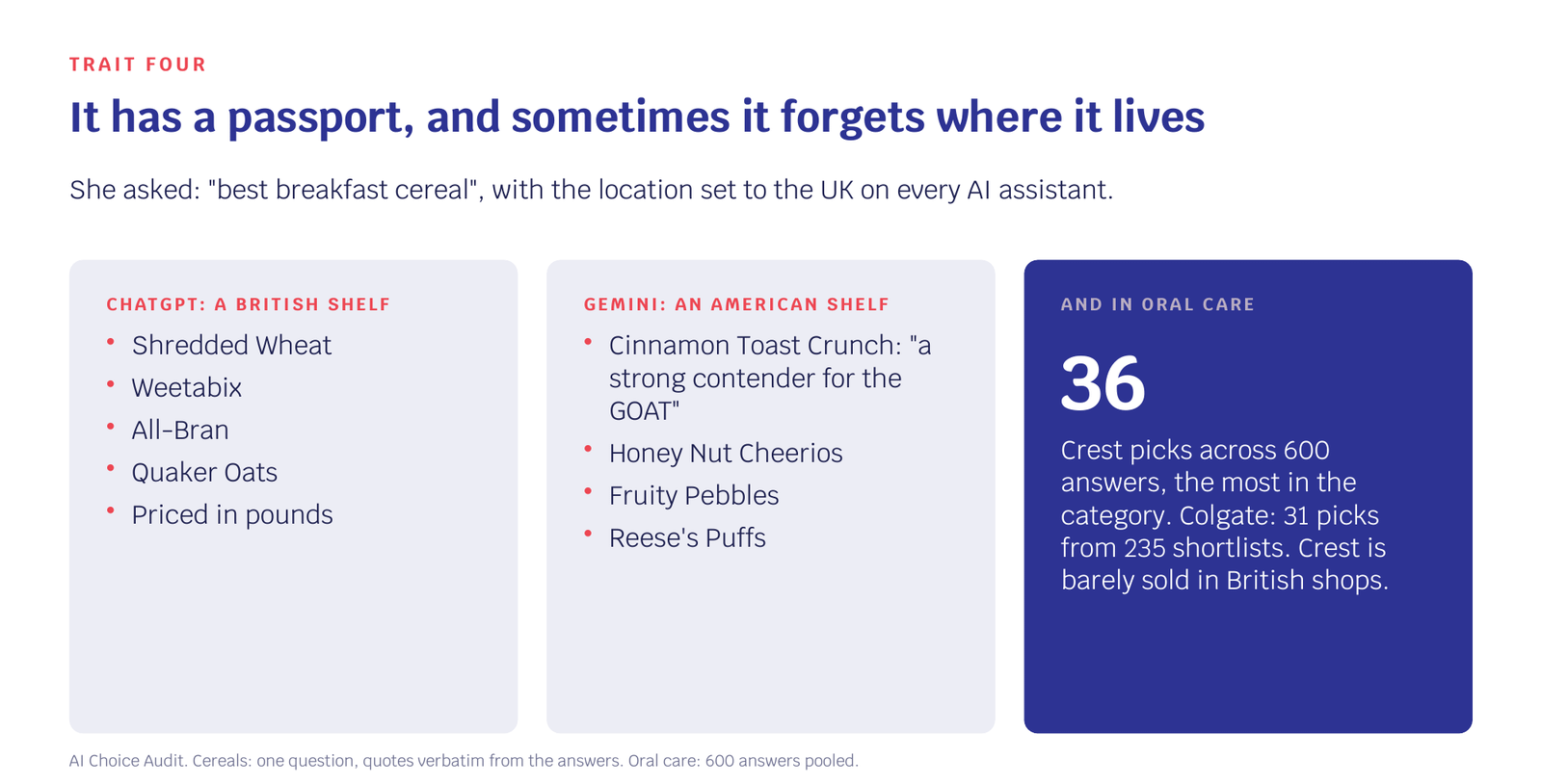
4: It has a passport, and sometimes it forgets where it lives.
I always run my audits from the UK. In oral care, across 600 answers, the toothpaste the AI assistants picked most often was Crest, 36 times, ahead of Colgate’s 31. Crest is barely sold in British shops. On those Black Friday questions, Gemini gave 42 of its 60 answers a US slant, quoting dollars and shops like Best Buy and Walmart to a shopper in Britain.
5: It doesn’t care for emotional brand building.
Everyone knows what Johnson’s Baby Shampoo smells like. The AI assistant doesn’t. Across 3,114 answers in 10 categories, 95.5% gave a reason about what’s in the product, and only 2.8% gave one about how it makes you feel. SEMRush’s UK data shows the same with Dove: when an AI assistant recommended Dove for a practical need, the Real Beauty campaign was the reason in none of 121 answers. Emotional brand building still builds equity with people.
The AI assistant just doesn’t read it.
Have a colleague who thinks their legacy brand equity makes them untouchable?
Hit share and gently help them over their morning coffee ☕️
Being found does not equal being chosen
Put those five traits together and you get the pattern that runs through the whole book. Plenty of famous brands get found. Far fewer get chosen.
Twinings made the top three 62 times across 240 tea answers and was never picked.
Pantene was shortlisted 44 times across 600 haircare answers and picked zero times.
Cetaphil took 72 top-three finishes across 642 skincare answers and no picks at all. CeraVe was picked 178 times.
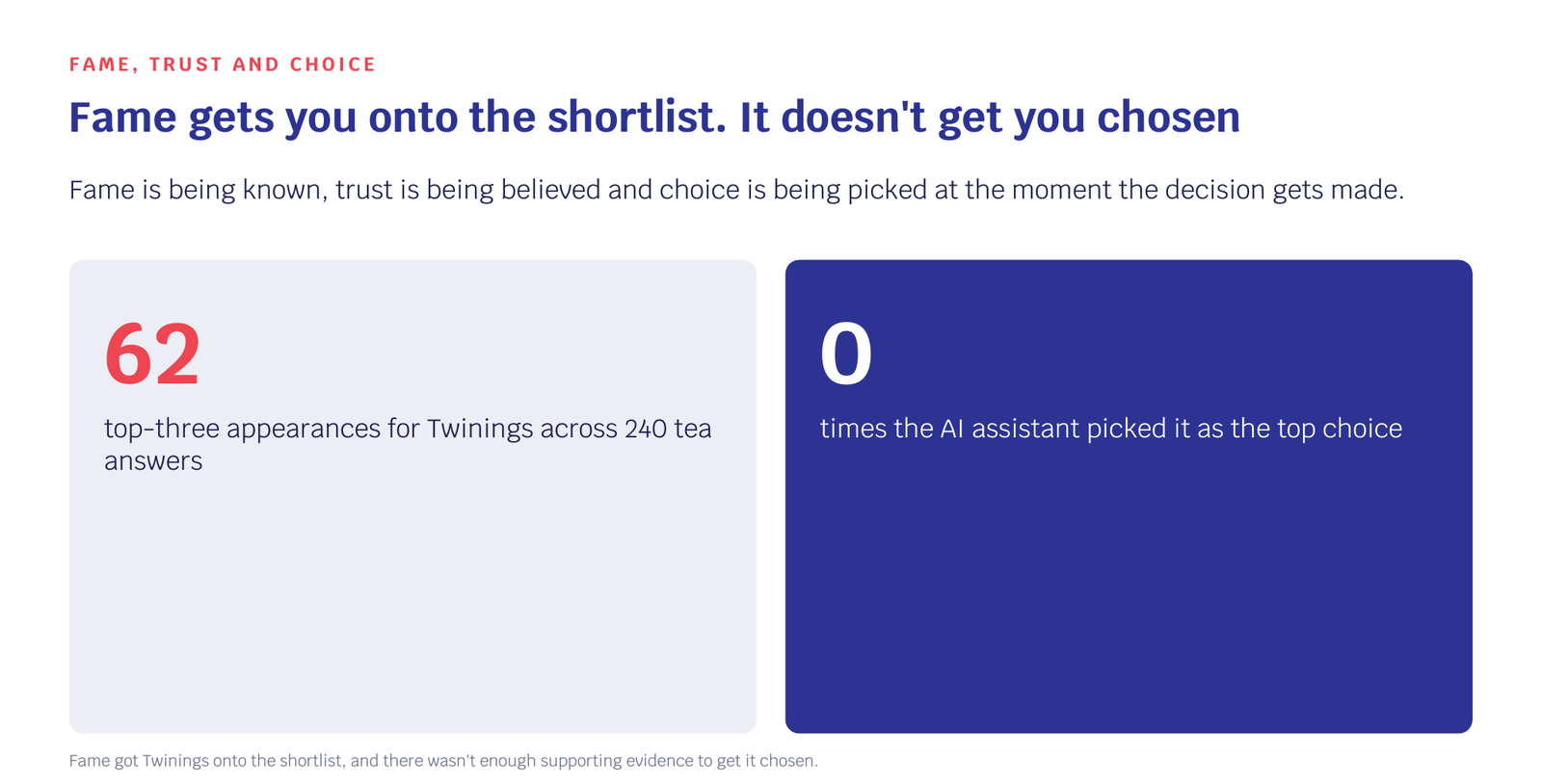
The AI assistant doesn’t know or care how famous you are. It reads the evidence, and most of it was written by reviewers, experts, journalists and people on Reddit.
Harry argued in this newsletter a few weeks ago that PR agencies are sitting on a winning lottery ticket, because AI assistants lean so heavily on earned media.
He’s right. Getting found is a data job. Getting chosen comes down to proof, and other people write most of it.
From being stocked to being selected
Winning the supermarket still gets you onto the physical shelf, and physical availability still decides how far a brand can scale.
The two buyers now run side by side, and you need to win both. Getting stocked is the trade buyer’s decision. Getting selected is The Invisible Buyer’s.
3 things to try this week:
Ask the way your shopper asks: Put your category to two or three AI assistants in plain words. Then ask again, describing the problem without naming a product, and compare the brands that come back.
Count three numbers: How often you’re named, how often you make the top three, and how often you’re the one it picks.
Check your proof: List the claims your brand is built on, and next to each one write who else says it. Where nobody does, The Invisible Buyer has nothing to repeat.
The Invisible Buyer is out now. It goes much further into each of these traits, with the data from all 13 categories and a five-step system for getting found, chosen and bought. If you’ve ever sat across the table from a supermarket buyer, I wrote it for you.
Copy & Paste To Share To Your Team: https://www.marketingunfiltered.co/p/109
Here are 3 takeaways from the Mark Ritson interview that were easy to miss if you only had chance to skim:
Generalists with AI beat hyper-specialists → Most industry chatter focuses on AI wiping out entry-level roles. The sharper point here is that narrow, tactical specialists face the biggest threat, while generalists who pair broad marketing fundamentals with AI become much more valuable. The trade-off is clear: going deep on a single platform gives fast early wins, but building broad strategic range offers far better long-term protection.
Senior imposter syndrome is often a training gap, not a mindset issue → Instead of treating self-doubt as a psychological hurdle, Mark frames it as a logical response to doing a job without formal education. He compares senior marketers operating without proper training to someone attempting surgery without a medical degree.
On the flip side, formal training takes time and money, and it cannot replace real-world commercial instincts, so it works best alongside hands-on experience. Exec coaching can also help to fill the gap or address concerns.Senior marketers frequently struggle with their “manager of managers” job → Beyond navigating company politics and setting vision, senior leaders have to manage advanced specialists whose daily technical work they no longer understand. The risk is either micromanaging from a place of insecurity or becoming completely detached from execution.
Your Practical Next Steps:
Audit your current team members skills mix to see if they rely too heavily on one narrow channel or tactic.
Pair one practical AI workflow with a core strategic task, such as running synthetic pricing or audience research before building a campaign.
Thanks for reading and have a great weekend!
& To those celebrating, Happy Thanksgiving!
Danny Denhard & Harry Lang
Such a relevant topic, expertly unpacked by Naureen. Go check out her book - a goldmine of rich insight gems to mine.