


Welcome back leaders!
This week Mr Paul Thomas returns with Marketing loves to hide behind “best practice” but what if that’s exactly what’s holding you back?
Paul shows how stepping outside your industry, and even your own function, will unlock sharper ideas and stronger commercial results. Paul teases stories from his past (enjoy the Britpop record stores to fibre broadband scale-ups) and shares how perspective beats playbooks when you’re trying to grow, this is packed full of song titles and lyrics - Paul’s calling card.
If you missed last week’s interview on how to win with PR and comms definitely take a read or watch here.
» If you would prefer to listen as a podcast, we are now live on Apple Podcasts & Spotify.

→ Did someone forward you this email? Join 2500+ curious CMOs and Marketing Leaders here
Or you can hit forward to share with your team.
📧 If you have any feedback, let us know how we’re doing, email us on mu@dannydenhard.com -
or if there are any specific topics you’d like covered let Harry and I know.
By Paul Thomas - Fractional CMO and The Sound Of - Listen To His Podcast
Marketing has an originality problem.
We call it best practice.
Work for an organisation long enough and it’s inevitable that you become institutionalised to some degree. However diverse the hiring policy, cultures breed groupthink. Norms you might have challenged on day one become Just The Way It Is quicker than any of us notice or would care to admit.
There’s no time, and often little incentive, to look outside, question the accepted wisdom or take a risk in the name of curiosity.
The same happens within specialisms.
Paradigms emerge.
Laws of gravity set in.
In marketing, it’s putting the customer at the heart of everything we do, product-led growth, The Long and the Short of It, CRM golden rules, pricing principles and whatever else is dominating LinkedIn this week.
These ideas aren’t wrong per se. Most became popular for a reason.
But when we stop asking whether they are on point Right Here, Right Now it’s easy to drift into mediocrity.
Attempts to broaden our thinking through peer networks, conferences and webinars can make things worse. We hear from people doing similar jobs, facing similar pressures and reading similar reports. We forget that B2B marketing still benefits from copy consumers would love, and that B2C processes can benefit from B2B funnel rigour.
The current zeitgeist gets reinforced. The reassuring average becomes the ambitious target.
Before long, we’re in “no one got fired for choosing IBM” territory.
Yes, we’re going agentic. We’re already testing ChatGPT ads. We only buy programmatic. Direct mail is dead. Our competitors are all doing it.
We call it benchmarking. Sometimes it is simply copying within narrow spreadsheets and paradigm norms.
And for a while, it can appear to work.
The KPIs you’ve set using industry benchmarks feel achievable.
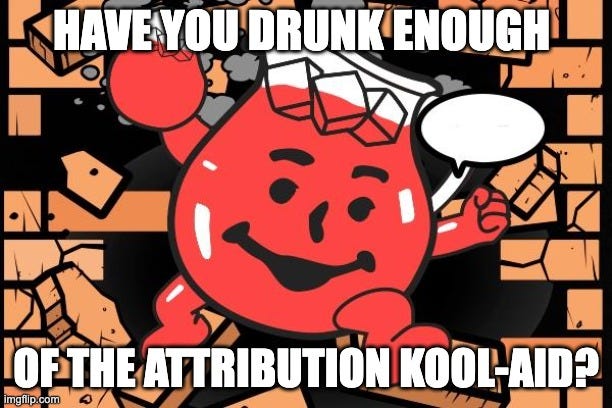
You might even hit them for a cycle or two. If you’ve drunk enough of the attribution Kool-Aid, it can feel like you’ve cracked it.
A rising market can make ordinary decisions look inspired.
But it never lasts. Customers move. Competitors learn. Companies get bloated. Technology and bureaucracy slow things down. What was once distinctive becomes familiar.
Through it all, you’ve been so focused on the inside view that you’ve lost sight of the outside.
Looking back, I’ve been lucky enough to catch a few rising tides. I worked in record shops at the height of the Britpop-fuelled CD boom. I moved into telecoms just as smartphones, apps, and 4G revolutionised the category. More recently, I worked in fibre broadband as challenger brands capitalised on incumbent sluggishness in sorting out the nation’s Wi-Fi.
Where I’ve learnt most - and probably added most value - is when I’ve crossed over.
I moved from working behind the counter in individual record shops to buying music at scale for multiple retailers. That taught me that buyers spend almost as much time selling as salespeople do.
Having sat in judgement on which compilation albums were marketable in Woolworths, I then got the chance to create and launch them into the same market for Sony BMG.
Everything I’d experienced further down the supply chain helped me understand what retailers needed and made me more credible when selling to them.
I produced and launched UK number-one albums.
I also got humbled regularly because around 70% of our concepts bombed.
For context, a three-in-ten hit rate was considered top quartile. It still stings.
The lesson wasn’t simply how to spot a hit. It was how to manage the whole process so that the winners paid for the misses and the portfolio still returned a decent profit.
When the credit crunch drove me to Orange in 2008 as a “good port in a storm”, I discovered that asking in May what the plan was for Christmas counted as a surprisingly subversive question.
This was a mega-brand helping define the future of connectivity. But the Argos catalogue deadline was six weeks away and nobody had decided which new phones we wanted to put in it.
The internal planning cycle said there was time. Retail said otherwise.
My previous world gave me a different clock.
Later, I joined a fibre scale-up that wanted to professionalise its commercial growth approach. My advice was to leave much of what EE and BT did to one side while sticking firmly to a few proven product, pricing and commercial principles.
That might sound contradictory. It isn’t.
Enjoying the post? Hit share and send to a friend
Cover the track but make it your own. Borrow the principle, not the playbook.
Outside-in thinking doesn’t mean automatically rejecting established expertise. It means separating the disciplines that endure from the rituals an industry has stopped questioning.
We doubled the customer base and revenue. Not because we blindly copied the incumbent, or because we did the opposite for the sake of it, but because we were selective about what we borrowed.
When I set out on my own in 2025, I called the business pro-spective.
The driving thought was that an outside perspective is valuable, but it shouldn’t always require a battalion of consultants, a vast transformation programme and a fee capable of creating its own EBITDA problem.
In all the roles I’ve described, I was no stranger to becoming institutionalised myself. I was part of the groupthink, too busy to get my head up and look around.
My edge was usually that I had arrived from somewhere different: the buyer who now needed to sell; the retailer leading product marketing; the big-company person learning how scale-up and private equity-backed businesses really work.
It has taken a year of self-employment and several clients for me to understand that more clearly.
My commercial experience, marketing savvy and leadership skills are the support acts.
The main event is perspective: curiosity, pattern recognition and the willingness to approach a familiar problem from an unfamiliar direction.
Rental refrigeration can learn from telecoms. Newspaper publishing can borrow from retail. Property PR and sports ticketing can reveal ideas that work elsewhere. In return, each new sector adds to the breadth of thinking I can take into the next one.
That doesn’t mean parachuting in with a bundle of supposedly clever answers.
It means asking better questions.
It’s also why I still draw constantly on my earliest retail experience. Why I visit call centres and warehouses, ride along with engineers and take every opportunity to hear from customers directly.
Retail taught me to follow both the customer and the money through the whole system: ordering, pricing, merchandising, serving, payment, returns and complaints.
When a business feels complicated, going back to that end-to-end journey often helps me work out where the things have gone out of tune.
So, if you sense it’s time to go outside more often, here are four questions to ask:
“If my business is making pop music, what might it sound like as a heavy metal cover version?” What would be different if we operated in another sector?
“Who’s Top of the Pops?” Who is doing something unusually well - and which of their methods could we steal? The more different the industry, the better.
“Who will challenge the arrangement rather than simply applaud the song?” A good producer won’t replace what makes you distinctive.
They will help you turn it into a hit.“Which belief would I question if I joined this business tomorrow?”
And why have I stopped questioning it now?
Best practice tells you what worked somewhere else.
Perspective helps you decide what could work Here and Now.
It’s always good to get Another Point Of View…
» Paul is a Fractional CMO and The Sound of… keynote speaker, combining business thought leadership with pop music to help teams find their growth rhythm. Connect with Paul on LinkedIn
Here are 3 refreshing doses of marketing from this week:
Thanks for reading and have a great weekend and we will land back in your inbox next Friday!
Danny Denhard & Harry Lang
PS I created a free worksheet to help your LinkedIn journey with Alicia’s brilliant interview
Excellent stuff from Paul Thomas