


Good morning leaders, welcome back!
This week we have Harry back tackling how you are dealing with LLMs and AI vs running away from it.
Last week I shared my time travelling experience and brought you ways to plan for H2 and this time next year:
The 2027 CMO Journal Entry

Find out why org design, agentic team members and cross-functional reliance is going to shape your experiences as Marketing leaders. Include 2 templates and frameworks to use and leverage
Thanks for reading and have a great weekend and we will see you again towards the end of next week.
In the AI Arms Race, Are You A Bazooka Or A BB Gun? As LLMs and AI tools improve daily, burying your head is not an option
You Wouldn’t Hit Yourself Over The Head With A Hammer. Nor would you leave it on the table and expect it to build an Ikea chest of draws while you sip a Latte on the sofa. LLMs are tools, and as with any tool, they’re useless without human intervention.
This is true for now - General AI might have a word to say about the premise when it arrives like an alien species and decides, rightfully, that the solution to all Earth’s woes is to exterminate its most pervasive parasite, namely us.
Earlier this week I ran a poll on LinkedIn with a simple question: -
What’s your competency level using AI for work?
The scoring criteria were relatively straightforward:-
0-2 - I’ve tried AI tools a handful of times but don’t use them as part of my regular workflow.
3-5 - I use AI tools regularly for specific tasks but still rely heavily on trial and error to get useful outputs.
6-8 - I prompt deliberately, iterate efficiently, have used agents with purpose and AI meaningfully accelerates my output quality or speed.
9-10 - AI and agents are deeply embedded in how I work and my results would be noticeably worse without it.
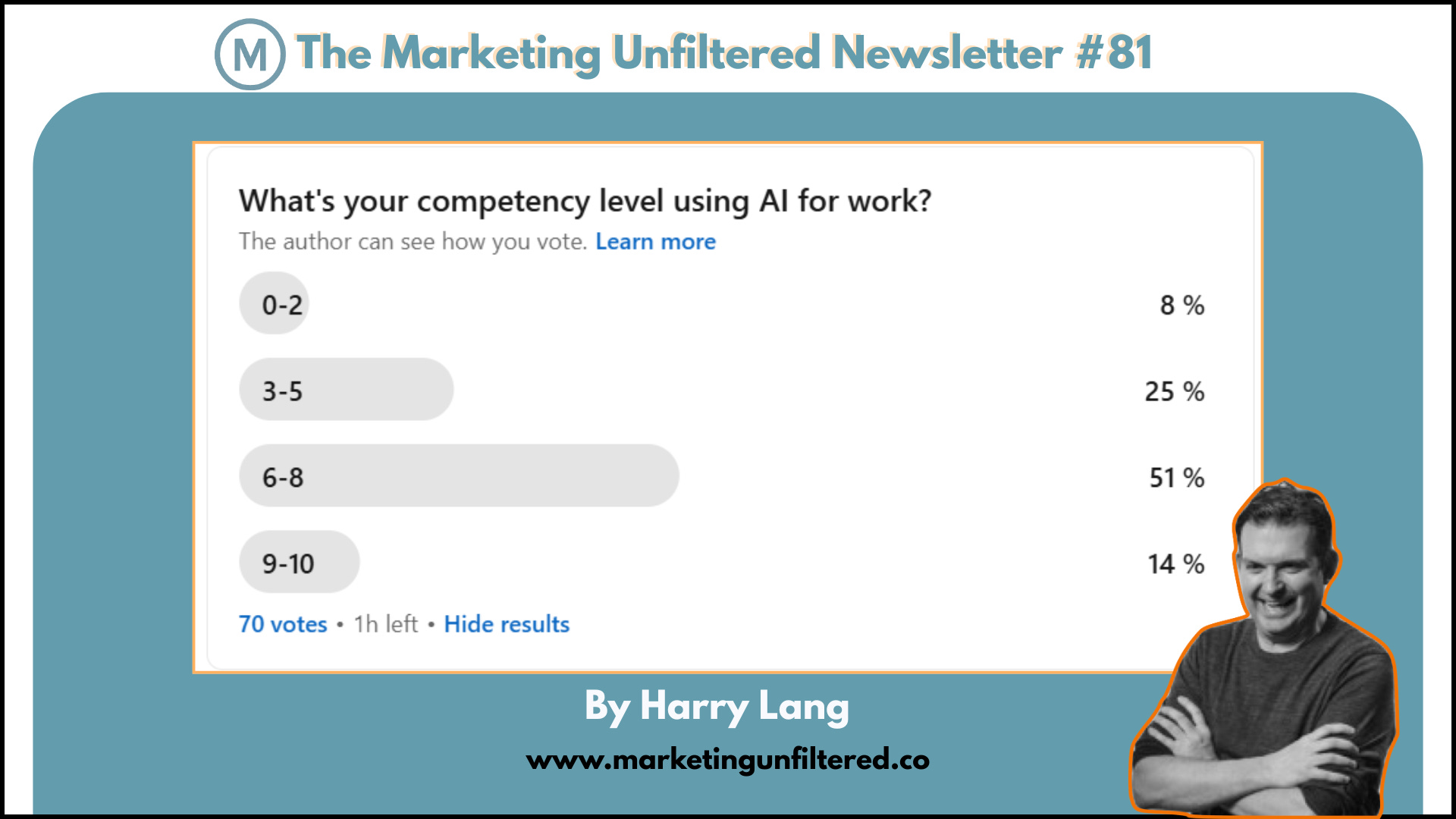
The results from 70 responses were interesting - 51% scored themselves 6-8 and only 8% claimed they’d yet to hop on the AI party bus.
However the survey results come with a couple of significant caveats:-
First, my network leans towards my own contemporaries, namely vintage (OK, older) marketing, iGaming, Web3 and technology professionals.
Second, I shared the survey with my friends in the CMO Circle Community which comprises 563 senior marketing professionals.
Just take a glance at the current state of the marketing industry and it’s no surprise that this community has been upskilling like a Victorian blacksmith the day after the first train chugged past his yard.
The results were kind of what I expected, with most senior professionals using it daily, intentionally, and with something to show for it but with a relatively significant 33% cohort either starting their journey or only dipping in occasionally. I regularly come across peers who treat AI at work with the same energy as a kid being forced to try broccoli ‘because it’s good for you’.
There’s a gap forming, and it’s widening daily.
The Illusion of Adoption
Here is what ‘learning AI’ from the ground up tends to look like in practice. Someone asks ChatGPT to write them an email. They get something that sounds like a BS corporate press release from 2011, so they tweak it heavily, and conclude that AI is either useful but limited, or significantly overhyped. They’ve used AI in the literal sense, but they haven’t even begun to understand what it’s capable of. This is surface-level adoption, and it’s commonplace (33% according to my straw poll)
McKinsey’s 2024 Global Survey found that while 65% of organisations now report using generative AI in at least one business function, the overwhelming majority are using it for narrow, low-complexity tasks. Drafting copy, summarising documents, basic Q&A that might be better achieved through Google. In some respects this low voltage level of AI use is like buying a Ferrari and only using it to drive to Lidl.
On the other hand, a 2023 MIT study found that workers who used AI effectively completed tasks 40% faster and produced outputs rated significantly higher in quality by independent evaluators. The only difference between the two groups being their understanding of tool usage and capability, and that capability is stretching every single month.
As Jensen Huang, CEO of Nvidia, put it in what’s now known as a cliche of the species:-
“AI is not going to take your job. Someone using AI is going to take your job.”
Personally, I would take a more nuanced view - someone using AI better than you will ALWAYS beat you in an interview process.
Who’s racing ahead, and who’s burying their head?
The finance sector is one of the most advanced adopters, though the gains seem to be more concentrated among upper tier employees. JPMorgan and Goldman Sachs have built proprietary AI models for data analysis, compliance and portfolio management. At the analyst level, many are still using AI the way a student uses it the night before a deadline. PwC’s 2024 AI Jobs Barometer found that tasks equivalent to 28% of the working week in financial services are now theoretically automatable.
Marketing has perhaps the highest volume of casual AI usage and despite what my survey suggests, marketers have some of the lowest scores in quality of application. Few have built any kind of structured workflow. As someone who has spent 25 years in this industry, I find it genuinely frightening how complacent our industry is. Content that once took a day now takes an hour. I built a credible website and GTM plan on a one hour train journey.
The marketers who do not adapt might not be fired, but they will become visibly, quantifiably less valuable and employable than the ones who do.
Legal is a fascinating case study in institutional resistance meeting an unstoppable force. The legal profession has always been conservative about new tools, and understandably so, but the dam is breaking. AI-powered platforms like Harvey and Luminance are now used by some of the world’s largest law firms. Research suggests AI can review contracts in minutes that would take junior lawyers hours, with comparable accuracy.
The concern about AI hallucinating case law is legitimate and worth taking seriously, but it’s a training problem - there’s a day coming not very far into the future when it will be human-level in quality and accuracy, so pretending imprecision protects against redundancy is simple, old fashioned apathy and is a high risk, low reward strategy.
HR has perhaps the highest untapped opportunity and the lowest meaningful adoption. Recruitment, onboarding, performance documentation, compliance training, policy drafting: virtually every high-volume HR task is a natural AI application and just look at Jack & Jill, the AI recruitment platform:- one day one in early 2025 it was clever but a bit shit and now, having raised $20 mil at a $600m valuation it has a serious (and seriously impressed) client roster.
Operations is where the real money is. Process optimisation, logistics, predictive maintenance, supply chain analysis: high-complexity, high-reward applications that go far beyond what a single prompt can achieve. However at the team leader and project coordinator level, AI literacy is often non-existent, especially in older, more traditional organisations.
Product sits at an interesting intersection. Product managers are broadly more tech-adjacent and quicker to experiment (validated by my recent experiences with a Product Director who is clearly level 10+ with an army of agents pulling all his workflows together seamlessly). Using AI to synthesise customer research, identify customer needs in qualitative data and stress-test hypotheses is an awesome product strategy, yet many product teams are lagging behind.
Sales is where the divide is starkest. Salesforce’s 2024 ‘State of Sales’ report found that high-performing sales reps are 3.5 times more likely to use AI tools than their underperforming counterparts. Not marginally more likely - three and a half times more likely. If you’re in sales and are not building your AI skills daily, you may as well explore a career selling encyclopedias door to door.
The Cost of Doing Nothing
The World Economic Forum’s Future of Jobs Report 2025 projects that 85 million roles may be displaced by AI and automation by 2030, while 97 million new roles will emerge better suited to a world where humans and machines divide the labour rationally.
What Using AI Well Looks Like
It’s absolutely not about being an expert in every tool - that would be a frickin’ nightmare, not to mention absurdly time consuming. New ones appear every 11 minutes or so, so instead of getting lost in that minefield of malevolent tech, you’re better off understanding base theory and learning what you need to know to excel in your specific role:-.
Learn how to structure a problem so that AI augments your judgement rather than replaces it.
Learn how to prompt effectively - get it to question you back (this works brilliantly).
Learn how to build systems rather than one-off queries.
Learn how to interrogate answers rather than picking the first result off the shelf like a discount packet of Hobnobs.
What’s Next?
If this is starting to feel like a reflection of you in the ‘casual user’ mirror, someone who’s dabbled but not built anything structured nor significantly useful, that’s excellent - you have foundations and enthusiasm and just need to turn your AI learning volume up a couple of notches. I’d suggest speaking to the likes of Oren Greenberg (who joined us on MU last year) to expand your skills and stay up to date with the latest AI tools capabilities.
If you’ve not started at all, I want to tell you something plainly so there’s no equivocation: the gap between ‘you’ and ‘useful’ is smaller than you think, and the cost of waiting is bigger than you can imagine. If you want to take your AI skills from zero to one, I’ve heard good things about The Oxford AI School.
Whether you think you’re level 1 or level 8, your competitor businesses (as well as those pesky 500+ candidates vying for that job you want so much) are not sitting on their hands, hoping this will all blow over like some weird dystopian dream.
Really solid piece Harry. One nuance to expand upon is that the "Marketing as repeatable workflows that can be automated" view is more prescient in certain contexts (e.g. B2B ABM, structured content creation for social media). Like any tech I caution starting with the customer/problem to be solved and then judging which tools solve for those best. Increasingly AI is a valuable part of the solution set and works best when balanced with human input, critical thinking and judgement.