


Welcome back leaders.
Have you seen the explosion of interest in the Prediction Markets the last six months or so? Some suggesting its just betting rebranded, some suggesting its just insider trading and others suggesting its the sanest way to gain true insights from interested parties.
Harry delivers another brilliant post on why his trip to Sin City to the Prediction Markets conference will be the start of how Marketers could leverage the platforms and gain real customer insights.
If you missed any of the last two week’s posts definitely check out Simon’s piece on change agents and my New Balance marketing playbook reverse engineered.
Have a great weekend and we will land in your inbox again next Friday.
» Was this forwarded to you? Sign up here.
What Happens In Vegas Affects You All…Why Sin City Will Help Predict The Future Of Everything
Next week, I’m flying to Las Vegas for the first time and those who know me might find that a little surprising.
“But Harry, didn’t you spend seventeen years working in online gambling? And didn’t you used to love a late-night party before your need for a decent night’s sleep overtook your desire to see every sunrise? How on earth did you never go to Vegas?!”
Fair points both of them but the fact is, Vegas never appealed to me.
I always viewed it as an artificial sandbox, a skin-deep pretence at fun that had the cultural depth of Pot Noodle and was actually a repository for the worst of human behaviours (see also the new cultural vacuum champion: - Dubai).
Added to that I worked in gambling, so if I ever did go, I wanted my Vegas story to be 10X the crazy/ hilarious/ unusual that everyone else came back with.
I’ll tell you how little I wanted to go to Vegas: -
In around 2010, I went to L.A. to do some skydiving. I popped down to San Diego for a night to stay with some friends, one of whom, Brad, is a photographer. While he left the next day for an assignment in Vegas, I went surfing, only to get a call from Brad late afternoon: -
“You wanna come and be my assistant tonight?”
“Who are you shooting?”
“I’m backstage, At Alice Cooper”.
I still didn’t go and yes, I still regret that myopic decision.
So now, over fifteen years later, I’m off to Vegas for a prediction market conference, flying via Denver for reasons I can only assume relate to jet fuel prices and the Strait of Hormuz.
For those of you of a non-gambling disposition, prediction markets are on-chain betting markets in which people back the outcomes of binary events. Any binary event, in fact, and it’s popular stuff.
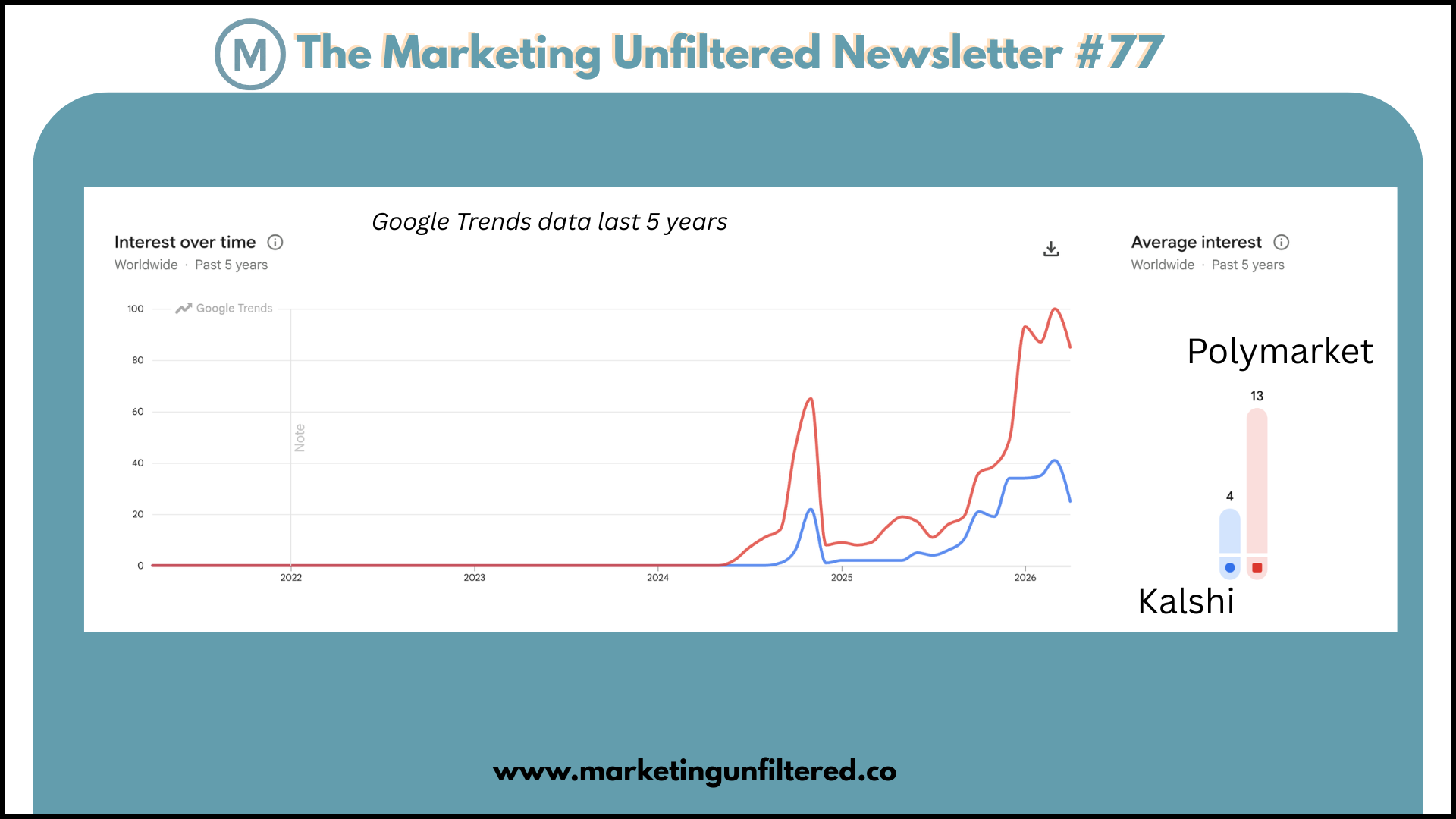
Between them, The Wall Street Journal estimates the two market leaders, Polymarket and Kalshi, are worth around $40 billion.
The thing is, this eye watering amount isn’t the most interesting thing about prediction markets – it’s their ability to read the future.
The sheer volume of data they’re able to accrue across geo-politics, sports, financial trading and crypto means their output is a scarily accurate reflection of what’s most likely to happen next.
As a result, Prediction Markets are making financial analysts obsolete.
Prediction markets are often seen by those outside Web3 as just another medium for gambling.
A new technology monetising the second oldest pastime on earth, but that view ignores a significantly more impactful use case.
Kalshi (the second biggest PM after PolyMarket) recently signed a deal with Fox News to share its prediction data which is now incorporated into numerous FOX News channels. According to Reuters, it will “...provide forecasts linked to political, economic, weather and cultural events”.
Kalshi said around 70% of its visitors use the platform to view forecasts rather than for trading (betting), flagging a growing demand for crowd-sourced probability data as a reliable information medium.
In January, PolyMarket signed a similar deal with Dow Jones having received a $2 Billion investment from Intercontinental Exchange (ICE) that valued it at over $9 billion. Data feeds from Polymarket are now being used to create the algorithms that influence trading in the global Brent crude futures market (the very same market that has me detouring via middle America next week).
The most important exchange for trading of Brent crude futures? Yep, that’ll be ICE, which rapidly launched a trading tool. According to a report in The Guardian this week, the tool provides a data feed of PolyMarket’s prediction markets to help traders “...consume crowdsourced probability assessments” as “market signals”.
Goldman Sachs, Morgan Stanley, Citigroup, UBS et al charge millions for expert analyst forecasts. ICE is now feeding its traders crowd-sourced probability data from an anonymous blockchain platform. When you realise which one performed better in predicting the last election, the last oil spike, the last rate decision, the last weather system, you’ll know this isn’t an anomaly.
None of this works without the infrastructure underneath it. The next era of prediction markets will need blockchains with enhanced AI resolution that can handle the volume and speed that global financial signals demand.
Prediciton Markets As A Crystal Ball For Marketers
This crystal ball opportunity matters more than most people in marketing have realised.
Marketers spend billions every year trying to predict human behaviour. Focus groups, brand trackers, sentiment analysis, social listening tools, quarterly brand health studies. The entire research industry exists because the future is opaque and decisions need to be made in advance. What if the future was already being priced in real time, by millions of people with skin in the game?
That is exactly what prediction markets do. And the signal quality is extraordinarily accurate.
When Kanye West announced his presidential run in 2020, PolyMarket traders had assigned it a 3% probability of going anywhere within 48 hours. Brand teams were still briefing agencies. When the Federal Reserve held rates in March 2024 against widespread analyst expectation of a cut, Kalshi had been pricing a hold at over 70% for two weeks.
While the Oscars shortlist leaked cultural momentum leaning towards Oppenheimer, prediction markets had priced it as the frontrunner months before the ceremony. This isn’t because market makers had inside information, it was because they aggregated what millions of people actually believed, rather than what a panel of twelve said in an air conditioned Hollywood broom closet.
This is the part that should unsettle and excite every marketer and business leader reading this.
Your brand strategy is built on data that looks backwards. Sales figures, campaign post-mortems, attribution models, NPS scores. Even the most sophisticated real-time social listening tools tell you what’s already happened. Prediction markets tell you what people currently believe will happen and that distinction is not subtle.
It’s the difference between a rear-view mirror and a windscreen.
Prediction markets have already demonstrated their accuracy in domains that matter to marketers. Category momentum questions on platforms like Kalshi, tracking whether a specific product category would outperform its sector within a defined timeframe, have consistently outperformed analyst consensus.
Political prediction markets called Brexit, Trump 2016 and Trump 2024 correctly when polling and punditry failed spectacularly.
Sports prediction markets priced team-sponsor sentiment shifts faster than any brand tracker on earth. And these are not outliers – they’re now the norm.
Now consider the marketing applications that are already within your reach.
A prediction market run on your category could tell you, in real time, what informed participants believe the probability is that your next product launch will resonate. Not what a sample of 400 recruited respondents says in a focus group but what people who have thought about it, and are willing to stake something on it, actually believe.
The difference in signal quality is not marginal.
Brand safety and cultural risk assessment through prediction markets could replace the current haphazard methodology. When prediction markets are applied to cultural flashpoints, sponsorship decisions and talent associations, they surface crowd-assessed risk probabilities before a campaign goes live rather than after it tanks.
Campaign outcome markets are already being piloted internally by a small number of agency groups. Before a major campaign launches, internal and external participants predict measurable outcomes against defined benchmarks and the resulting probability distribution tells them more about genuine confidence in the creative than any focus group debrief ever will.
Competitor intelligence is perhaps the most immediate application. Prediction markets on product launches, leadership changes, pricing moves and category disruptions are already running on public platforms.
That data is available. Most marketing teams are not looking at it.
The broader implication is this: - Marketing has always claimed to be the discipline closest to the customer – we’re meant to represent the customer and speak for the customer – that much is unequivocal.
Prediction markets, when applied to brand and category questions, are the first mechanism that actually delivers on that claim at scale and in real time. They’re not a replacement for strategy – they’re the most honest knowledge feed you’ve ever had access to.
The marketers who recognise this early will have an advantage over every competitor still commissioning quarterly trackers and waiting six weeks for a blended soup of a report.
Prediction Markets aren’t just a platform that let people to bet on the News - they’re anonymised databases that allow the masses to highlight what happens next.
It’s now a question of ‘when’ not ‘if’ the likes of Kalshi and Polymarket will shake off their ‘grimy gambling platform’ label and become elevated in the public perception as the most accurate information medium available.
The bigger question is when prediction markets are recognised to be the most valid forecasting medium, who will own the crystal ball?
Harry Lang - Follow on X or Connect on LinkedIn
I enjoyed this one in particular - prediction markets go waaaay beyond betting - they're oracles powered by crowd opinion