


Good Morning!
FIRSTLY THANK YOU! We would like to thank the 2500+ who support us from an idea we had over email and then started to send out in October 2024, we started Marketing Unfiltered from our own frustrations with how marketing was being reported and articles and comments were becoming overly edited → to a newsletter and interview series we are incredibly proud of sending each and every week. Now around 2 years later we have hit 100.
So thank you for joining us on the rollercoaster of Marketing, Growth and Business world for the last 100 newsletters.
We would also like to thank our contributors, the people who gave up their time and expertise to share with you for free (connect with them on LinkedIn/Substack below)
Writers: John Lyons, Simon Swan, Paul Thomas, Radmila Blazheska, Jessie Allen, Sarah Aird-Mash, Faisal Laljee, Emma Clayton
Interviews: Alicia Teltz, Andy Barr, Katie McPhee, Rory Woodbridge, Chris Hutchings , Carl Hendy, Katie Barnes , Oren Greenberg, Rick Guttridge, Lottie Unwin, Joe Glover, James Hamlin & Nicola Anderson.
Commentators: Beth Gladstone , Xavier Vallee, Kathryn E. Strachan, Amita Fearon, Leilah King-Gotlib, Nicola Vidal, Neil Campbell, Helen Forsyth, Sophie Collins & Jonathan Wagstaffe.

ENTER ROOM 101 For today’s celebration of MU100, Harry and I celebrated with a room 101 edition, we broke it down into 3 categories, Unfiltered, Controversial and Confession, while asking our brilliant contributors what they’d banish in room 101.
Over the last few weeks you will have seen my ask for what you would want to banish into room 101. Harry and I created ours but I also reached out to our great contributors to see theirs:
The Hot Takes & Recommendations For Room 101
John Lyons
I’d kill MQLs and SQLs, and I’d enjoy it.
Untrained so-called marketers with a huge platform miseducating their followers with self-serving BS. <Names Redacted>
Calling marketing a profession when no accreditation or basic standards exist and any **** (see above) can call themselves a marketer.
SWOT analysis.
Gurus, Rock Stars and f—king Ninjas
Read John’s Articles On Marketing Unfiltered
Simon Swan
Dashboards with no context
Decisions made with quant but no qual data
Recruiting based on IQ and not EQ
Read Simon’s Articles On Marketing Unfiltered
Nicola Anderson
Is the tendency for everyone to say xxxx is dead! SDRs are dead, Direct Mail is dead, MQLs are dead, outbound email is dead. So dramatic and never quite true.
Read Nicola’s Takes On Marketing Unfiltered
Oren Greenberg
What I would banish is performative marketing. The obsession with activity that presents in multiple nefarious forms, such as a weekly social media cadence or blog content cadence. It becomes a hyper focus trying to grab attention using a volume approach. This is a mistake because it’s devoid of commercial impact or changing buyer behaviour. It’s become in many companies an exercise in practicing shallowness. The ultimate example is posting on a LinkedIn company page. So many companies are doing it, posting two or three times a week, and they’re evaluating and comparing these metrics, like likes and comments, without any clarity on how it’s impacting the business if at all
Read Oren’s Take On Marketing Unfiltered
Beth Gladstone
Brands that leave comments on civilian Instagram & TikTok posts (Happy Socks & Aldi as the worst offenders) - it worked when it was new and novel, but now it’s just giving weird uncle
Marketing job ads right now - not only does “marketing” seem to require fluency across strategy, growth, organic, paid, data, AI/tech and leadership, but I read one job ad yesterday that gave 20 bullet points of requirements for the role (including being able to speak fluent Portuguese) then listed “a laptop” as the first benefit…
AI content factories - using AI to scale mediocre marketing, whether that’s hundreds of ads which aren’t actually giving results, or publishing tons of blog content just to show up for vague, TOFU keywords which aren’t linked to leads or customers. Even with AI I’ll still be out here advising fewer, better bets…
Managers who ask ChatGPT “who is the best company for X” during meetings then get annoyed when their brand doesn’t show up
Read Beth Take’s On Marketing Unfiltered
ARE WE YOUR DIRTY SECRET? Or are we helping you a little each week?
We have one ask, you hit share/copy & paste to your favourite industry group or on LinkedIn - https://www.marketingunfiltered.co/subscribe
THE PODCAST 😮
Because of how unfiltered our chat gets (well mostly Harry 😉) I had to edit slightly more than I’d like for YouTube and enjoy below
On Spotify
Or click play at the top of this post
Harry & My Submissions To Room 101
Unfiltered 📢
Harry’s: Danny Tommo’s Far-Right Patriots/Activist Movement.
It’s spearheaded by a bunch of “pig s—t thick, racist, misogynistic, job-avoiding turds” marching around in balaclavas and Stone Island gear.
It cynically exploits the economic frustrations of disenfranchised people on the fringes of society to build a toxic, grievance-driven counterculture.
They’re running a vile race-to-the-bottom playbook, targeting respected institutions like the RNLI purely to stir up hate and grab cheap headlines.
Although it’s an example of rapid brand and community building, it’s built through it’s toxic messaging. The group effectively utilises digital tools like email CRMs and anonymised messaging groups (WhatsApp and Snap) to organise and engage its “followers”.
Ignoring such groups is dangerous because they successfully appeal to disenfranchised people on the peripheries of society.
Ultimately, the group’s mobilisation tactics act as a sobering lesson in understanding community building, even though the movement itself belongs in Room 101.
Even though they’ve somehow cracked rapid community mobilisation, what they’re peddling is so aggressively awful that it belongs locked away at the bottom of Room 101.
Danny’s: Brands Who Are Constant Trend Chasers.
Why? It’s lazy, uninspiring and almost always misses the mark. So many have fallen into the trap to stand for something or have a say on everything and rarely does this help. The question I ask many Marketing leaders is: Does a “trend” last for more than a few days now, does it help your brand? Does it stick in potential customers mind for good reasons? Did they come and buy from you or use your service from this?
Don’t just jump on or copy any social trend or copy any subject line that competitors send out:
Going after politics and playing with political updates - doesn’t do you any favours and alienates you to customers (not everyone can be Ben & Jerry’s and stomach it for decades)
Especially those who fall for the random gifting on TikTok - random reward culture isn’t having the effect they think it is the best brands
Controversial 😱
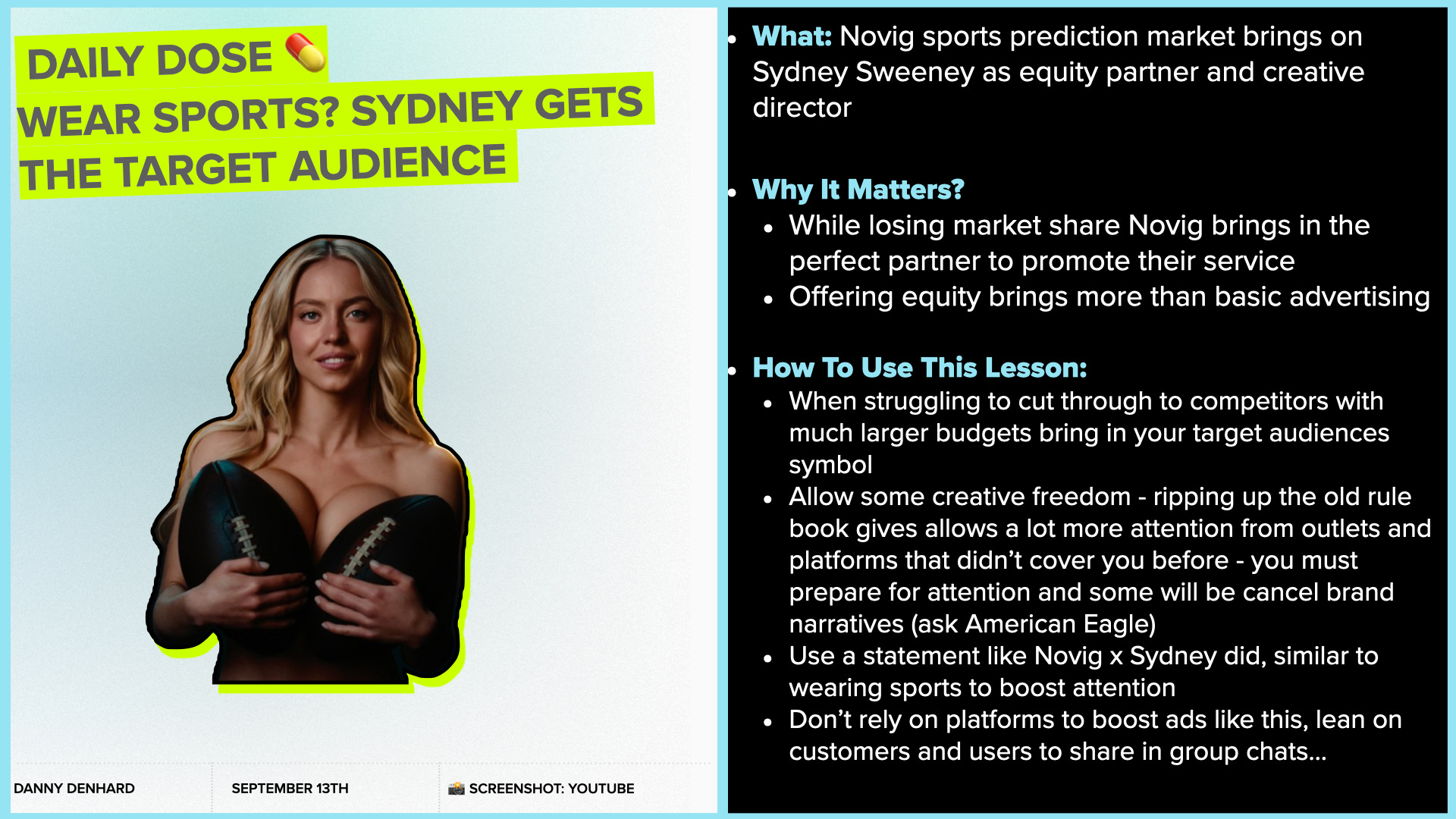
Harry’s: Novig x Sydney Sweeney Ad
Why he is banishing them into Room 101:
Cynical Value-Pumping: The brand (Novig) is a prediction market set up by heavily funded tech grads who needed quick visibility and customer acquisition to validate their massive valuation, falling market share and had to use the campaign as a shortcut.
The “Grimy” Playbook: The reliance on an overtly sexualized “sex sells” angle to manufacture global visibility and clicks.
Intentional “Sex Sells” Controversy: The campaign intentionally uses suggestive imagery to spark public debate and outrage, successfully driving millions of views, free PR, SEO, and clicks for the brand.
Regressive Optics: The overall dynamic makes it feel like “women’s empowerment goes backwards a few years”
Strategic Equity Partnership: Novig granted Sydney Sweeney an equity stake and creative control as director to leverage her star power and secure global visibility.
Above is the ad no-one saw but is the safer version that Sydney was also the creative director on alongside the more controversial ad below.
Harry banishes everyone except Sydney Sweeney into the bin.
He doesn’t fault Sweeney because she played the business game brilliantly, securing a lucrative equity deal and creative control, essentially pulling off a clever monetization move. Instead, he is banishing the creators, the cynical mechanics behind the prediction market brand, and the predictable, regressive execution designed solely to buy artificial salience and hype.
Danny’s: Many Leaders Don’t Understand The Importance Of Org Design
Your org design is likely killing you by a thousand cuts and the ripples it causes is hindering your departments performance.
I thought I would share a coachable moment below:
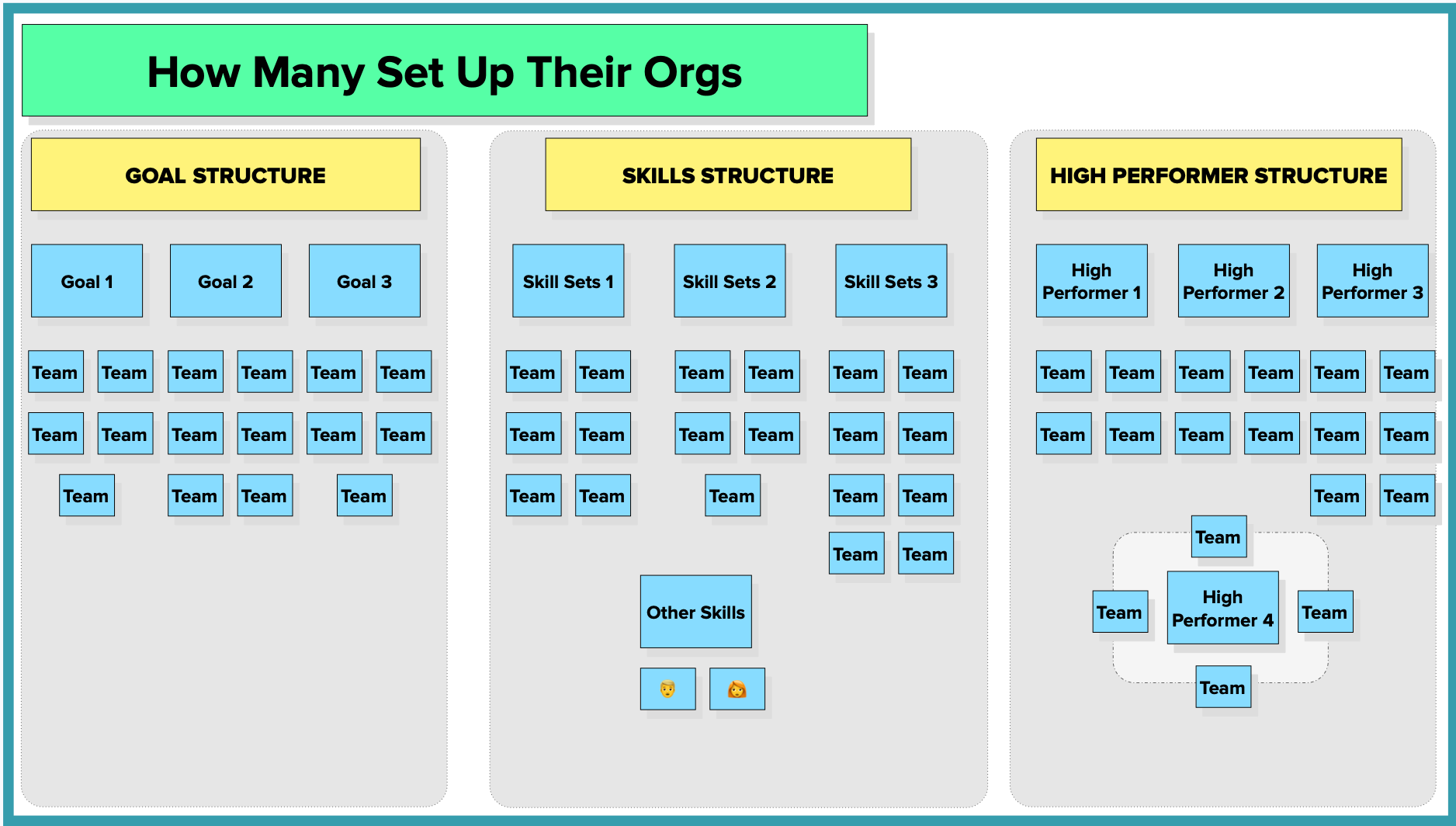
Teams are usually set up in 3 types of ways
(1) Goal structure - goal 1-5 teams underneath
(2) Skill structure skills and team associated and
(3) High performer structure - higher performer and then teams around it
These often do not connect and creates negative second and third order effects on how you work, how you are viewed and how your team choose to operate, often you will hear you ship your org chart, often in Marketing its true and its how it works team to team and cross functionally.
Bad Org Design Ripples:
Your colleagues don’t know who is working on what or who to go to updates or insights
In your department and cross-functionally no-one is sure who owns anything or who is leading important projects - they default by going to the team lead and often that’s inaccurate
You start creating job titles that make no sense to the team or the business, this impacts you more than you realise. The “lead” role appears, the head of or director of role makes less sense, you create confusion internally and it starts bleeding into the work and output from that team and the department
You start to try to rebalance things frequently, leading to constant re-orgs and strategic shifts, these are strong signals the C-Suite leader didn’t plan and design their department well enough
Your teams have their own “strategies” SEO strategy, social media strategy etc, these often never connect to your Department plan and then go against the company strategy and struggle to connect to the goals
Good Org Design
Aligns structure, scope and decision rights with strategy, it’s a clear signal to your business, this means decisions and flow of information do not get stuck in slios.
There are clear ownership paths and people who are accountable for decisions, for outcomes and metrics are clear. Team members and cross-functional colleagues know what people own, co-own and collaborate on.
This comes from how you design your org to how it communicates (your teams connect to your department and as a leader the confusion and misunderstanding shows up in subtle and non subtle ways) and shows up.
Structure and strategy tend to align well and rewarded well in good org design and kills the performative angle to meetings and the constant need to have meetings. Good org design also should reduce political games as remove ambiguity and shadow structures show themselves quickly.
Titles And Roles Misalignment
I also included freedom around titles like Founding CMO (no one knows what this means or if you have someone smart in the role) and the Fractional CMO title, which is often misleading, regularly used to inflate the size of a business (by the owners or founders) and is constantly overused and misused, which causes numerous ripples, especially when specialists (for example, SEOs) use the title of fractional CMO and it has a negative impact on Marketing’s abilities.
There are some brilliant fractional CMOs who can deliver incredible work, however, it is being undone by misuse and over-use of the title!
And when the CMO is removed and replaced by a fractional CMO the same problem often stays as they do not plan out the org and do not have the time, energy or resources to reshape effectively.
Confession 🔓
Harry’s: Attending Conferences For Deals Not To Attend Talks
Harry confesses that during his time in the gambling industry, he spent a period of about 5 years attending the Amsterdam Affiliate Conference primarily as a perk.
Includes hosting a dinner for his major affiliate partners at a swanky canal-side restaurant or penthouse steak bar, he used the rest of the trip as a break from day to day work.
Harry admits that for the last 4 years of attending, he didn’t actually step foot inside the actual conference once but did justify the trip by noting that all the real business deals had already been finalised in the weeks leading up to the event, making the conference itself unnecessary for closing contracts.
Instead of attending conference sessions, he spent his time enjoying three days off in Amsterdam doing tourist activities like visiting Anne Frank’s house, going to the Van Gogh Museum, taking canal boat trips, and riding bikes.
Danny’s: Big Logo Hires/Resume & CV Hires Rarely Ever Work Out.
Why? Culturally too different, apply their old way of working vs trying to implement the best ways of working.
Often will only refer back to the old way and not the way that works for your business and how to incorporate it.
Frequently used as a tactic within in large businesses, in those large businesses like Google, Meta etc there were 3-10 versions of the new hire on different product lines
These big logo hires have rarely ever had any exposure or influence over the C-Suite and it then shows in meetings at their new company and they don’t work out or ever ask how to be successful in the new workplace - they default to a muscle memory
I have hired from large logos and they struggled to work out, I have worked in and with businesses who use this and it frequently backfires quickly.
My Other Items That Didn’t Make The Cut But You Might Agree With:
Marketing to what your team members see, not what or who your customers are and what they see (so obsessing over TikTok and the sub culture and language used there, for an audience who just don’t use it) 🚮
Jargon and Buzzword Bingo - Get back to speaking customer language, make it simple! 🚮
Senior marketers who say “Too old to learn a new channel” or too old for TikTok - quickest way to discredit yourself 🚮
Sending SMS, email and push notifications at the same time - never works 🚮
Kill the word Users - customers, people, why dehumanise it? 🚮
NPS is disposable, noisy, gamed and low-diagnostic - going out to random customers once to understand how you’re doing. Often misleads and brings attention to the wrong parts of the business. It does force a conversation about loyalty and advocacy, not just “satisfaction”. I have used it and hated every time (it does like we say in the pod, have a political play) 🚮
The C-suites who have contempt for their customer. Customers can be only seen as wallets and purses and often it’s then consumed by the most senior marketer who should reflect both business and customer. 🚮
Thanks again for being a part of the journey and if you’d like to write or contribute yourself please do get in touch, we are also taking on sponsorship applications, so hit reply and get in touch or email mu@dannydenhard.com
Have a great weekend!
Danny & Harry
You can scroll through our previous posts, our full back catalogue is open and unlocked


