


Good Morning Leaders,
Thank you for your responses to the hiring and job scams newsletter last week. If you missed it please take a read after Harry dropping some branding wisdom.

On this week’s MU
A little teaser: Most law firms are quietly printing money while spending less on marketing than you did last quarter’s offsite. Harry’s latest MU post shows how their obsession with billable hours, cookie‑cutter brands and AI denial is creating a once‑in‑a‑generation opportunity for bolder, braver marketers. If you want a live case study in what happens when a whole industry under invests in brand, innovation and AI, maybe start with the lawyers 😉
What Action To Take? Subscribe | Sponsor us! | Share
Traditional Law Firms Are Dying From Marketing Myopia - AI Is Just The Final Bullet

Harry Lang - Training leaders at The Oxford AI School - Connect On Linkedin. Read more of my MU articles here.
Why did you appoint the last law firm you worked with? Or if you’re a lawyer, why did your last client hire you? Chances are, yours and their decision making process was based on one or more of these three things:-
Reputation - you had a particular legal issue they specialise in solving
Recommendation - somebody you know and trust said they’d be a good pick
Remuneration - you’re required to employ a credible lawyer, but wanted to spend the bare minimum
This has been the way for eons. Law was - and is - a serious business dealing with serious topics with serious implications. People want safe, secure, reliable lawyers and are prepared to pay a premium to ensure they get the result they need. In turn, law firms in the UK and beyond have made an extremely profitable niche for themselves by eschewing innovation - effectively creating a domain in which a safe, solid, and perceptibly boring law firm is seen as a reputable, trustworthy and reliable law firm.
Bear in mind that law firms are B2B and B2C businesses, with clients who decide whether to pick them over another costly room full of highly educated suits. There’s very little in the way of brand differentiation, and I reckon they all look the same on purpose, fearing that standing out might make them look somewhat less ‘lawyer-ish’.
Blands Not Brands
Just look at how lawyers represent themselves to the casual observer - corporate, generic, safe gatekeepers of the law. Reassuring but purposefully bland experts who can be trusted to keep you out of trouble whilst divorcing you from large sums of money. As a marketer, I’m astounded that nobody has seen fit to update the model by creating a law firm brand with a more appealing, engaging and differentiated positioning in order to stand out from the lookalike crowd beyond price and reputation alone.
This question came to mind recently when I had a fascinating discussion with a former law firm CEO. He estimated that legal firms in the UK spend around 3% of their net revenue on marketing. Not on brand, not on their marketing headcount, not on digital media costs, not just on events - 3% to cover ALL OF IT!
1.7%
It turns out this 3% figure was a generous overestimation, representing only the upper quartile of law firm marketing spends. The Law Society’s 2026 Financial Benchmarking Survey found that the median law firm spends just 1.7% of fee income on marketing, and that figure includes the salaries of its marketing team. A quarter spent no more than 1%, while even the upper quartile begins at only 2.8%. Among firms turning over less than £2 million, the median is a frankly pointless 0.9%.
Split even that upper quartile 3% across multiple channels with multiple client industry sectors and multiple media, and you rapidly get to a place where the spend is meaningless - so insignificant as to be barely perceptible. The only conclusion you can draw is that lawyers don’t think marketing is a high priority for their future business success - it’s a wasteful, frivolous cost centre that only exists to drain partner equity pots.
Perhaps they’re right, but how does this measly 3% compare with the percentage of revenue spent on marketing by other notable industries?
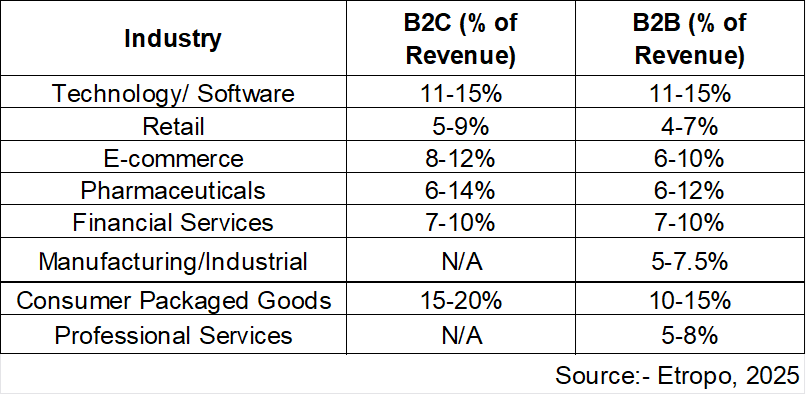
Everyone else, including other professional services businesses, are happy to invest in marketing to a significant scale in the long term, one presumes because they’ve seen commercial benefits as a result. It’s only lawyers who are clearly above that sort of long-term strategic thinking.
A brief scan of the UK’s top ten law firm websites should give an inclination on where their pitiful marketing budget is being spent. You might think they’d be pretty good at differentiating their brands in other ways other than expensive ad campaigns and celebrity endorsements, right?
You’d be wrong.
Blending In
Law firms seem to care so little for brand differentiation, they apparently briefed the design of their websites to an apathetic twelve year old with a free Wordpress account and a secondhand copy of the Black’s Law Dictionary.
The problem is, law firms are demonstrating significant growth without the need to invest in marketing. The recent Law Society survey reported that 85% of firms achieved year-on-year fee growth, 55% grew by at least 10%, and 22% grew by at least 20%. This is all well and good, but just IMAGINE what they could achieve with a little imagination and a cohesive integrated marketing strategy, rather than just sitting on their hands enjoying stable organic growth?
This is what I mean - the below site might look familiar to any of you lawyers reading this. It should - it’s an AI generated amalgamation of the homepages of the top ten law firms in the world, and it’s the epitome of corporate cookie cutter design. A soup of mediocrity without one single redeeming feature. Its design on such an unimaginatively turgid level, the AI that produced it pulled out its own plug afterwards.

Think I’m being unduly unfair? Like I’m kicking those wealthy heartbreakers and lawmakers in a fit of pique through some misplaced career success jealousy?
No - I’m not.
Ripe For Disruption?
This is what those top ten law firm websites actually looked like before I smashed them together into a merged montage:-
JUST LOOK AT THEM! The identikit, lookalike headline placements alone make me want to Napalm my laptop and demand a refund from Getty Images on their behalf.

“Yes, I’d very much like to buy my funeral from these people”
“Or maybe a new suit?”
“Perhaps shop for colour swatches, specifically brown, blue, black and grey ones”
“...Or hire a photographer, but very specifically a short one who can only shoot impressive buildings from ground level…”
Just imagine, for one second, how easy it would be to dominate share of voice as one of these top ten law firms if you just took a dose of strategic and creative bravery:-
A slightly more uplifting colour swatch?
A brand personality that has some actual personality?
A tone of voice not inspired by 16th century Franciscan monks?
A font suite that doesn’t make you crave Comic Sans?
Imagery not stolen from the 2003 Moss Bros catalogue?
Copy that made me feel anything but sleepily morose?
Website UI that took me on a journey to somewhere - anywhere - worthwhile?
And that’s just for starters, before we spend any of their hard earned cash on events, PR, content marketing, KOLs, sponsorship and paid media…
Innovating with new tech to speed up case management, client communications and billing? That just means less billable hours on the clock.
Deploying agentic AI to increase the speed and accuracy of mundane research and replicable task efficiency. How can we maintain our hourly rate if clients know we ‘cheated’?
Updating brand and marketing capabilities to create a more appealing, inclusive and human organisation so clients and employees feel a greater emotional attachment and loyalty to our business. What?! And risk decades of stoic sameness and reliable partner equity splits?
Oh no you don’t - my bolthole in the Cotswolds costs a fortune to heat in winter!
Billions
According to a 2026 report by The American Lawyer, the top ten law firms generated revenues ranging from $3.1 billion to over $10.5 billion for the 2025 fiscal year.
Notably, Kirkland & Ellis made history by becoming the world’s first firm to cross the $10 billion single-year revenue milestone. They might see this as a prize to covet, but undoubtedly the Big Tech and AI behemoths will see it as a formerly impregnable vault ripe for raiding.
Enter AI
Which brings us, eventually, to the question of AI.
All industries will benefit / succumb to AI eventually. Some have embraced it, and are thriving as a result. Others, like many law firms, clearly see it as a threat to their livelihoods and are flapping desperately in the other direction like a besuited Icarus, failing to recognise that the glowing pot of gold they can see on the horizon is actually an AI-fuelled inferno for their business.
“But you can’t replace us!” I hear a harem of besuited lawyers cry. “We’re a corporate necessity, essential to commercial life - lawyers are the bloody water of capitalism!”
Chill out - nobody’s trying to replace you. AI systems can’t operate without a human in the loop, but just think like a client for one second. If you’re choosing between two lawyers, and one is faster, cheaper and better because they’ve embedded AI in their systems, which one would you choose?
Automation, research capabilities, business management, marketing, performance management, billing automation, client communications, case drafting - they’re all right there in shiny LLM packaging, and they’re getting better every week.
The dominant legal tools are a handful of tailor made AI platforms sitting on top of the leading foundation models. Harvey is the market leader while CoCounsel from Thomson Reuters’ runs it a close second. Then you’ve got Legora, Luminance and a handful of challenger brands fighting to grab land, eyeballs and budgets. They all do largely the same things, namely document reviews, due diligence, contract analysis, legal research and first drafts.
Of the legal behemoths, both Slaughter and May and A&O Shearman rolled Harvey while Linklaters picked Legora, Freshfields went balls deep into Anthropic. Adoption across the rest of the industry is more scattered with 41% of law firms reporting integrated use of generative AI. Separately, more than half of all firms surveyed have given staff no training on responsible use and crucially, they don’t plan to. Metaphorically, you have a train steaming way down the tracks and a number of carriages rolling backwards towards a precipice.
You’d need to have your head so deep in the sand you’re seeing kangaroos to miss the fact that these early, massive ‘AI Adopter’ law firms have already made their moves, so my advice would be to embrace the age of AI, nurture change, encourage differentiation and relish the inevitable chaos that such foundational change tends to ignite.
Some commentators have flagged fears the legal AI tools are simply hoovering data to preempt their ultimate goal of replacing the very clients who are funding them, but this has been largely (and unsurprisingly) denied by the Harveys and Legoras of this world.
Harvey states unequivocally that it does not train its models on client data and “...client documents are used at inference time only and then not absorbed into the model’s weights”. It runs tenant-level isolation, ethical walls, audit logging and contractual guarantees that a law firm’s client data stays within its own gated garden. Whether this is true or not will only be revealed in the course of time, but commercially it stacks up - Harvey has ballooned to a valuation of more than $11 Billion by looking after its law form clients and playing by the rules - it’s not incentivised to sh*t where it sleeps.
Innovate & Market To Win The Legal Game
So not all lawyers hate AI and innovation - but some of them seem to reject the premise of change. If you’ve made a niche as highly profitable as this, and retirement is beckoning you from a hill five years distant, why on earth would you choose to make your services cheaper, easier and faster? You’d be the turkey voting for Christmas, which is all well and good until rival firms take the initiative with that critical first mover AI advantage, leaving you scrabbling for ‘no win, no fee’ clients like an ambulance chasing hack.
Change and progress are inevitable, as demonstrated by the industry heavyweights, but it’s not too late to join the bandwagon. Act now, and you become the chased rather than the chaser.
Fail to do so and you’ll be stuck with the other legal also rans - a morose corporate website, a fraying suit and the well thumbed brochure for a French chateau that you once dreamed of owning.
Thanks for reading this week Harry.
If you would like to read my previous MU articles, select your favourite here
Harry Lang runs The Oxford AI School which teaches teams the basics of AI in an intuitive and practical way. The school has modules to cater for numerous industries, including law firms. Harry is the author of ‘Brands, Bandwagons & Bullsh*t,’ available on Amazon. You can connect with him on LinkedIn, check out his socials or email him to book an AI training course at Harry@TheOxfordAISchool.com
PS. Here are the 3 campaigns & smart choices you might have missed:
Article Sources
41% of firms using generative AI - Thomson Reuters 2026 report
54% of firms provide no AI training and don’t plan to - 8am 2026 Legal Industry Report (ABA)
Slaughter and May adopts Harvey firmwide - Artificial Lawyer
Harvey: Security by Design (does not train on client data) — Harvey
Law firm marketing spend benchmarks (~2–5% vs ~7–10%) — MyCase
2026 marketing budget benchmarks for professional service firms — Align
A little louder for the lawyers in the back! You should see what it's like for the marketers INSIDE those firms... It's like a down trodden strata of 2nd class citizens - sometimes referred to as 'Fee Burners', can you believe?
Fascinating to research this one, and I'm looking forward to seeing which law forms break ranks first.