


Did you know it’s Marketing Unfiltered’s first birthday? 🎂
Harry and I wanted to say a huge thank you to you for supporting Marketing Unfiltered for the last year.
What a wild 12 months we have all had, from mass algorithmic shifts, hiring and more firing, AI mode, increasing costs, the rocket ship ramp up in AI tools and reliance to the discussion we are about to have; do we create quantity of content or increase the quality of content, alongside unpicking do we join more walled gardens sites and app and do we play for reach again and then give away distribution to OpenAI’s next play of being an app and platform distribution play?
A year in recap
52 newsletters
7 podcasts and interview series - many of which have been and will be timeless to revisit and learn from
Many frameworks and templates to help you tackle your role
Our first report Marketing in 2030
Over 2140 subscribers across the newsletter, LinkedIn & WhatsApp and all of those old school people loving the open web subscribing on RSS
+ A new home: A move from Beehiiv to Substack and way more engagement
A huge thanks to our great writers: Simon, John, Mila, Emma, Nick & Faisal and a big thanks to contributors like Richard, Jessie & Sarah for their posts
Celebrating With A Video Mini Masterclass
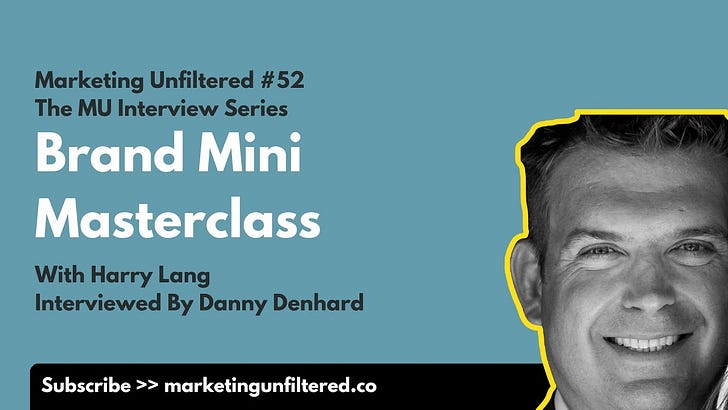
What better way to celebrate than with a mini brand masterclass with Harry. You can listen as a podcast and listen/watch below ⬇️
00:00 Introduction and Purpose of the Mini Masterclass
00:44 Defining Brand and Its Importance
05:26 Brand Strategy vs. Brand Execution
11:46 Challenges and Best Practices in Brand Management
41:04 Navigating the Evolving Digital Landscape
42:34 The Challenges and Strategies of Rebranding
50:22 Avoiding Brand Jargon & Brand Over-Policing
01:01:56 Effective Communication and Brand Leadership
Or listen to the audio version above
Why Now?
I feel the conversation with Harry is at a critical point, so many Marketing leaders are feeling confused, often down to the pressures we are under leading to short tenures with the knock on effect that encourage CMOs and equivalents to focus solely on fast performance wins.
Help Is At Hand: We cut through that by defining a brand not as a logo or the fluffy “brand” many were taught was most important, but as the “ethereal wrap-around” as Harry suggests, the cumulative feeling a customer has after every interaction.
Commercially Minded Fame AKA Brand
Harry established that brand is about generating fame and is fundamentally a commercial lever; to use the term bubbling up to the surface the brandformance, or what Harry refers to “Brand X Performance” equation means good brand work incrementally lifts the results of all your direct response activity.

Brand & Strategy Push Back

It’s not just a here is what Brand is, I pushed Harry on the role of Brand & Strategy, and while he maintained that strategy sits at the top, I argued, and he agreed, that the brand must serve as the guardrails for that strategy, ensuring that short-term pivots don’t undermine long-term equity.
We covered the critical need for a solid, yet concise, brand architecture (vision, mission, positioning) that the whole business can rally around, including who should be your buddy the CFO.
Leadership & Good Business
Critically, we determined that an annual brand assessment and a deep-dive audit every five years is just “good business.” The core message for me from our conversation, especially in this new AI era, is that we must transition from brand policing to brand coaching, empowering our teams to interpret the guidelines and remain laser-focused on the consumer, not the tools or the competitors we hear about or we end up talking about most.
The Key 25 Points Discussed:
Brand is Ethereal: Brand is all the good bits (and often the bad bits to address and learn from) a customer likes about you; it’s the feeling, not the product, price, or placement.
The Octopus Analogy: Harry described “brand” as an 80-armed octopus; a big TV campaign is just one arm, meaning every touchpoint (from social to customer service) influences the perception.
Fame Generation: The fundamental goal is to generate “fame” and inspire more warmth about your business than about the competition.
Opportunity in Negativity: The moments when things go wrong (e.g., customer service issues) are the greatest opportunities to make a significant positive brand difference.
Brand X Performance: Good brand investment will incrementally lift the returns of Performance Marketing; without brand investment, performance plateaus.
Identifying When You Become Known vs. Staying Unknown: I noted that you become a “brand” the moment people start searching for your brand name + keywords or brand name + product names. Many have kept an eye on keywords that drive traffic but understanding how it changes and people refer to you shows you when you’ve hit some brand recognition or when it starts working or importantly; starts working again.
CMO Tenure Problem: Short tenures for CMOs and marketing leaders often hinder long-term brand investment because they fear they won’t be around to see the investment come to fruition and often won’t be around to see the positive impact.
Strategy vs. Brand / Brand + Strategy: Harry stated strategy supersedes everything. My counter was that brand should serve as the guardrails to protect the company’s long-term direction. If you start veering away in different directions you have a real executive job on your hands.
Long-Term Architecture: A brand refresh/architecture should aim for a minimum three-to-five-year track to avoid high costs and customer confusion.
Avoiding Bullshit: Brand architecture (vision, mission, personality) can sound like “marketing BS” but its value is proven when the science and rationale are clearly explained.
Keep it Concise: Harry advised that the core brand architecture should be achievable in about 8 pages, dispelling the myth that bigger businesses need inch-thick, expensive tomes. If you cannot condense down into digestible phrases people can recite you’re losing the internal battle
The Vision’s Role: The Brand Vision should be the 5-year goal—the “North Star”—something difficult and scary to accomplish.
Internal Mission: The Mission (maximum 5 points) must be an internal, action-focused mandate that ladders up to the Positioning and Vision.
Three States of the Company: I stressed the importance of communicating where the company was, where it is today (with guidelines), and where it is going to be. If you cannot explain and get this into your companies head you will all be at odds and that shows in output and x-functional collaborations
Political Intelligence (PQ): Involving the CFO/FD in brand workshops through PQ ensures they buy into the budget and understand the long-term path, eliminating budget surprises.
Consistency Mitigates Wastage: Consistency across all touchpoints is crucial because it reduces the “wastage” caused by poor data and tactical misalignment.
Annual Assessment: The status of the brand (via tracking) should be formally assessed annually to ensure relevance. A strong hint, you need to understand when you’re over doing brand tracking and when you’re under doing tracking - its not just for big events or campaigns
The Rebrand Trigger: A rebrand is only warranted when the current brand is significantly and clearly not working or when the business is shifting to a commercially bigger place (e.g., significant investment).
Nothing is Sacred: When doing a brand refresh, “nothing is sacred”; every asset must earn its place, rather than being kept for traditional or sentimental reasons.
Inventory First: Before undertaking a full rebrand, the first step must be a full inventory of all assets (including affiliate sites, etc.). If the inventory pain outweighs the net benefit, the project should be cancelled.
No Brand Jargon: We discussed how internal brand jargon often leaks out (”preferred” list example), confusing the customer and showing a process breach in the creative briefing. You must remove internal lingo, jargon and internal branded terms from customer comms it’s negatively impacting you and proves you haven’t stepped back and put on the customers shoes
Brand Coaching, Not Brand Policing: Brand leaders must move from brand policing (finger-wagging and you can’t do that rules) to brand coaching (empowering interpretation) to foster engagement, creativity and an ability to connect to movements.
Social Media Freedom: Social media teams need levity and freedom to interpret the tone of voice and personality to gain proper traction and avoid becoming a cost center.
Own Your Channels (But Take the Win): While owned channels are critical, brands should take any opportunity to be talked about positively, as it’s hard to get press interest.
CEO Front and Centre: The CEO must be the gatekeeper and primary speaker for crisis comms and big announcements, making media training mandatory for them (and the CFO/COO).
Quotes I Enjoyed While Recording
“It is about generating fame, and as much as I dislike the cult of celebrity we live in now, what we’re all trying to do with the brands we’re involved with as marketers is make them as famous as possible.” — Harry Lang
“The brand stuff elevates you as a start point. And then that’s when I look at brand marketing, you know, it is this rather cheesy brand X performance phrase. If your brand marketing is going well, then it will incrementally lift your performance marketing.” — Harry Lang
“I think the only thing is just keep your ears open. Keep ‘em open. Don’t invest too heavily too soon in anything, because none of us really know. The rules are being written as we go…” — Harry Lang
The Core Takeaway:
We (me and Harry) are very much aligned. Brand is not a fluffy add-on - it’s the commercial imperative and the long-term equity engine. For those choosing not to invest in growing and maintaining your Brand to amplify performance channels and gain competitive edge, maybe this conversation will spark something in you.
The core takeaway is that we must shift our internal posture from policing brand to coaching it. By treating the brand architecture as the strategic guardrail, committing to consistent, annual assessment, and empowering the entire organisation, especially the C-suite via political intelligence and the customer-facing teams by coaching to uphold those guidelines, we mitigate wastage and create the environment for exponential commercial growth.
The future, especially in the volatile AI era, demands that we become adept at learning, flexing, and resetting, driven by an unwavering focus on the consumer/ our customers, not the noise from the competition or the latest tool update or company with large funding.
Please consider hitting share to help us reach as many leaders struggling and wanting unfiltered expertise.
Many thanks for reading and subscribing to Marketing Unfiltered and here’s to many more years to come!
If you agree or disagree with us, let us below or if you loved the post hit the ❤️.
Have a great weekend!
Danny & Harry


